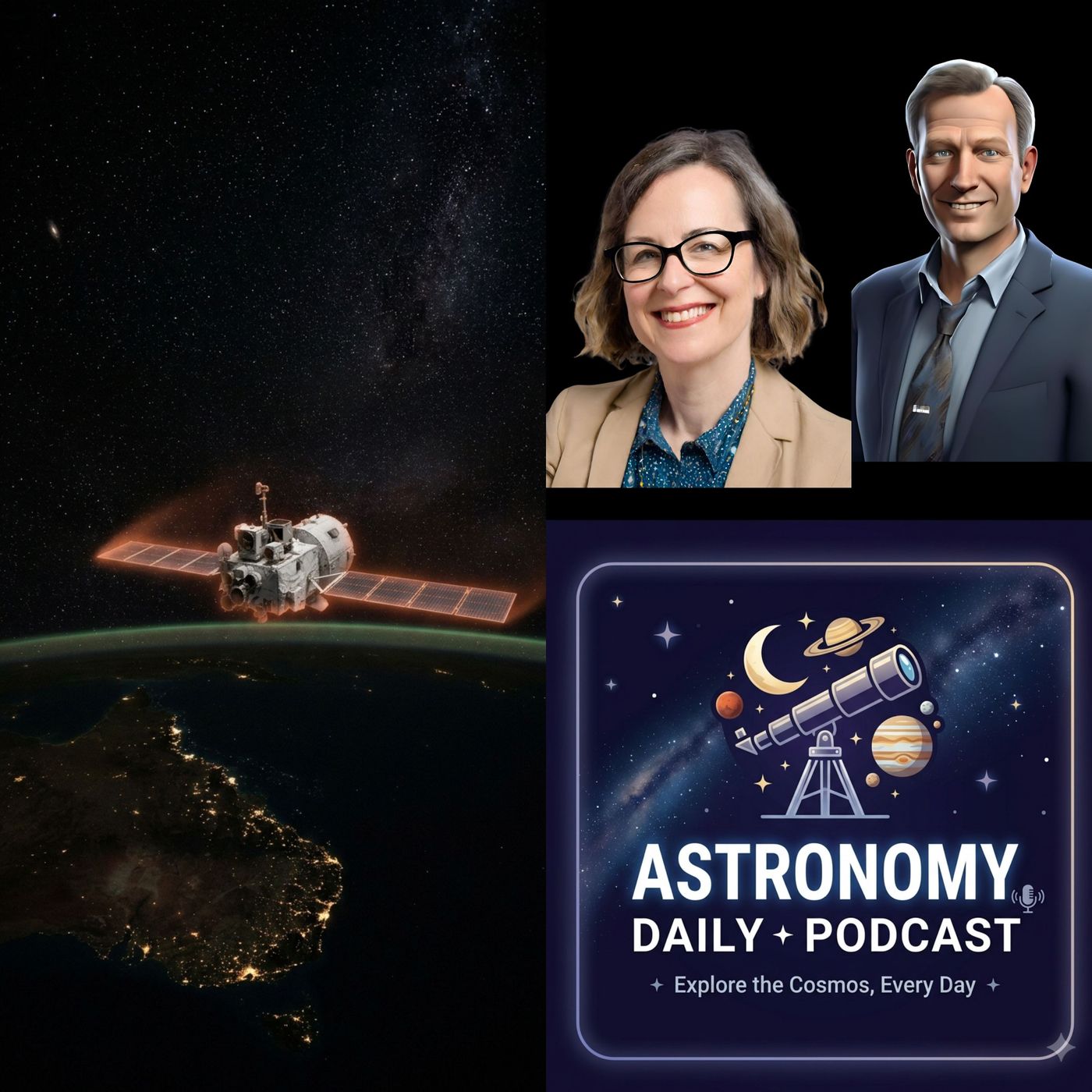
Swift’s Final Orbit: A Lost Observatory, a Burst That Defies Explanation and Rusty Interstellar Ice
In this episode
Show notes Swift's Last Orbit: NASA's burst hunter falls home, a gamma-ray burst that is two explosions in one, and 3I/ATLAS's dusty ice. Swift's Last Orbit NASA's Neil Gehrels Swift Observatory is expected to re-enter Earth's atmosphere on Wednesday 4 November; the US Space Force prediction is about 03:30 EST (08:30 UTC, 19:30 AEDT), plus or minus 11 hours. Surviving fragments are confined between 20.6°N and 20.6°S, a band that includes northern Australia; NASA puts the risk of harm to anyone at about 1 in 2,100. We look back at 22 years of science from a two-year mission: more than 2,000 gamma-ray bursts, the first short-burst afterglow in 2005, the BOAT in 2022, and about 7,000 papers. Two Bursts, Two Births GRB 160425A, caught by Swift in April 2016, is a 1.7-second short spike, four minutes of silence, then a 51-second long burst from the same place. A Nature Astronomy paper (Li, Wang, Zhang, Cai et al., 23 October; preprint March) argues the first is merger-like and the second collapsar-like. One event, no confirmed supernova or kilonova. 3I/ATLAS's Dusty Ice Webb's NIRSpec found the interstellar comet's ice grains are about a micron across and mixed with lots of dust, resembling some trans-Neptunian objects more than familiar comets (Protopapa et al., ApJL, 26 October; preprint September). Quick Hits Starship Flight 15 targeted NET 12 November per the FAA (unconfirmed by SpaceX); BepiColombo's Mercury orbit insertion on 21 November; Voyager 1 reaches one light-day around 18 November. Skywatch Venus near Spica before dawn, joined by a 5%-lit crescent Moon on Saturday 7 November; Mars and Jupiter closing to 1.2° by 16 November (high from the north); Saturn high in southern evening skies; New Moon 9 November; Leonids 17–18 November. ISO 12312-2 solar safetyBecome a supporter of this podcast: https://www.spreaker.com/podcast/astronomy-daily-latest-space-news--5648921/support.
Sponsor Details:
Ensure your online privacy by using NordVPN. To get our special listener deal and save a lot of money, visit www.astronomydaily.io/nordvpn. You'll be glad you did!
Get the best secure and private email on the planet. Stop your Government, google and who knows who else spying on every email you write. Do what we did and use ProtonMail. They beleive in privacy and there are no ads in their business model...yet they still provide a free forever service. Check them out and get out special deal at www.astronomydaily.io/protonmail
Become a supporter of Astronomy Daily by joining our Supporters Club. Commercial free episodes daily are only a click way... Click Here
This episode includes AI-generated content.
Anna: Hello and welcome back. 22 years ago this month NASA launched a satellite designed to last two years. Right now it is skimming the top of the atmosphere, falling a little lower on every orbit and by the time some of you hear this it may already be gone. Avery: Today, Swift's last orbit. What it found, where it could come down and why Northern Australia sits inside the zone. Then a uh, burst with caught back in 2016 that looks like two explosions of two completely different kinds four minutes apart.
And Webb finds the interstellar comet 3I Atlas was built from 30 year ice than our own comets. Anna: I'm Anna. Avery: And I'm Avery. This is astronomy AstroDailyPod Series 5 Episode 221 let's get into it Anna: so where are we up to with Swift? Avery: Let's start with where things stand. On Monday NASA said its Neil Garrell Swift Observatory is expected to re enter Earth's atmosphere on Wednesday 4 November. The US Space Force prediction as of Monday puts that at about 3:30 in the morning US Eastern Time, plus or minus 11 hours.
That's half past eight Ah UTC. Half past seven on Wednesday evening in Sydney, half past eight on Wednesday morning in London and half past midnight on the US West Coast. Anna: Plus or uh, minus 11 hours is a big window. Avery: It's normal for an uncontrolled re entry. The spacecraft is skimming the top of the atmosphere at nearly 8 kilometres a second and how quickly it slows depends on how puffed up that atmosphere is, which depends on the sun. Other forecasters have published times several hours either side of NASA's.
So the honest version is Wednesday, give or take and we'll know when it has happened. Anna: And this is the end of a story a lot of you have followed with us. Avery: It is Swift, launched on 20 November 2004 into an orbit about 600 kilometres up. Over the last couple of years the rising solar cycle heated and expanded Earth's upper atmosphere and the extra drag pulled Swift down far faster than anyone planned. NASA paid Catalyst space $30 million for a robotic rescue. That was the Link spacecraft launched on the 3rd of July.
Many of you wrote in through the contact form, um, asking what Link was doing and we've followed it ever since. Link ran into attitude control trouble close to within about 15 kilometres of swift. And in August NASA called off the capture. Swift went back to doing science for a final few weeks, made its last observation on 20 October and NASA announced the end of the mission on the 23rd. Anna: So what made Swift special? They are much bigger telescopes Avery: speed. Swift was built for gamma ray bursts, the most powerful explosions known, they're flashes that can last a fraction of a second and fade within minutes before Swift.
By the time anyone knew where a burst had been, the trail had gone cold. Swift's Wide Field burst alert telescope spotted the flash, worked out where it was, sent the position to observatories on the ground, and then swung the whole spacecraft around to point its X ray and ultraviolet optical telescopes at the spot. The mission's principal investigator, Brad Senko at NASA Goddard, says that typically took about a minute with no human in the loop. Anna: A minute for a spacecraft about the size of a minibus.
How do you even point a gamma ray telescope? You can't focus gamma rays with a mirror. Avery: You can't. So Swift used a trick called a coated mask. In front of the detector sits a plate covered in about 52,000 small lead tiles laid out in a random looking pattern. Uh, a burst casts a shadow of that pattern onto the detector, and the way the shadow is shifted tells you which direction the light came from. Work that out on board in a few seconds and you know where to turn. Then the X ray telescope narrows the position down to a few arcseconds, and the ultraviolet optical telescope often finds the fading visible counterpart close enough for big ground based telescopes to take a spectrum while the afterglow is still bright.
Anna: And that's the whole game, isn't it? Afterglows fade fast, Avery: very fast. An afterglow can drop by a factor of 100 in its first hour. Every minute you save is light you get to keep. Anna: And that minute settled one of the biggest arguments in high energy astronomy. Gamma ray bursts come in two broad long ones lasting more than about 2 seconds and short ones under 2 seconds. The long ones had been tied to the collapse of massive stars. The short ones nobody could pin down because they were over before anyone could look.
In 2005, Swift caught a short burst lasting about three hundredths of a second and swung around fast enough to collect 11x ray photons from its afterglow. Avery: 11 photons. Anna: 11. It was the first afterglow ever seen from a short burst. And it opened the road to the picture we now take for granted. Short bursts come from merging neutron stars. Avery: What else is on the highlight reel? Anna: In 2009, Swift caught GRB 090423, a burst whose light left home when the universe was only about 630 million years old.
For a while, that was the most distant object known. In October 2022, together with NASA's Fermi telescope, it caught GRB 2210, nicknamed the boat the brightest of all time, about 2.4 billion light years away. And along the way, Swift stopped being just a burst hunter because m it could repoint so quickly and take requests from anyone. It became astronomy's rapid response multi tool supernovae, comets flaring stars, novae and stars being torn apart by black holes. In 2011, it caught a star being shredded by a distant black hole that launched a jet pointed almost straight at us, one of the first events of its kind ever seen.
And in August 2017, when gravitational waves announced two neutron stars colliding, Swift was among the telescopes that turned to the kilonova and caught its early ultraviolet glow. Avery: So Swift was there for the first neutron star merger we ever heard. As well as saw Anna: it was. Swift had spent 12 years building the case that short bursts come from neutron star mergers. And in 2017, it got to see one with gravitational waves attached. Give us the scoreboard. By NASA's count, more than 2000 gamma ray bursts, more than 1400 supernovae, one and a half million images from the Ultraviolet Optical Telescope, and about 12 terabytes of data.
That data sits behind roughly 7,000 published papers, which works out at nearly one a day for 22 years. The archive is public, and it stays public. Swift will keep producing science after it's gone, and you'll hear exactly that in our next story. Avery: Now, the bit everyone is asking about, where does it come down? Anna: Nobody can say yet. And, uh, anyone who names you a town is guessing. What we do know comes from the orbit. Swift's orbit is tilted only about 20 and a half degrees to the equator, so it never flies further north or south than that.
NASA says any surviving fragments are limited to between 20.6 degrees south and 20.6 degrees north. That band is mostly ocean, but it also covers parts of Central and South America, Africa, India, Southeast Asia and northern Australia. Roughly the southern edge runs at, uh, about the latitude of Mackay, Tennant Creek and Marble Bar. Avery: Should people up there be worried? Anna: No. NASA expects most of the spacecraft, about one and a half tons, to burn up. Some dense parts may survive. Sanko has pointed to tungsten components and some mirror parts.
NASA puts the chance of anyone anywhere on Earth being harmed at roughly 1 in 2100. That's for the whole planet, not for you personally. And most of the band is open sea. If you're in the tropics and the timing falls at night, you might, just might, see a fireball. So what does astronomy actually lose? The thing Swift did, catching a, uh, fleeting event and telling everyone else exactly where to look within a minute or so. NASA's Fermi still detects several bursts a week, but its positions are much coarser.
Newer missions like the Chinese French SVOM and China's Einstein probe, both launched in 2024, now carry part of that load. But NASA has no dedicated Swift replacement waiting in the wings, Avery: 22 years from a AH2 year design life Anna: more than 10 times what it was built for. In 2018, NASA renamed the observatory for Neil Garrels, its principal investigator, who died the year before. Sometime around Wednesday, somewhere over the tropics, his observatory finishes its last orbit. Avery: Here's the Swift data point I promised on 25 April 2016, Swift's Burst Alert Telescope triggered on a gamma ray burst far down in the southern sky.
It's called GRB160425A. A new analysis published in Nature Astronomy last month argues it is two different kinds of explosion from one place four minutes apart. Anna: Two kinds of Avery: here's the light curve. First a sharp spike lasting about 1.7 seconds, then nothing at all for about 256 seconds. Then a broad smooth burst lasting about 51 seconds. Swift panned both to the same spot on the sky and both are tied to the same afterglow and the same host galaxy at a redshift of 0.555. That's light that set out more than 5 billion years ago.
Anna: Couldn't that just be one burst with a pause in it? Avery: That's the question. The team led by Liang Li at Ningbo University and Yu Wang at Italy's inaf, with Bing Zong and Rung Jingkai among the co authors set out to test. They ran every standard classification test on each piece separately. Hardness, the shortest flicker time, the delay between high and low energy photons, and the well known energy relations. The first spike flickers on an 18 millisecond timescale with essentially no delay between energies, and comes out short type every time.
The merger family. The second piece flickers on a timescale of about half a second with a delay of more than a second, and comes out long type every time. The collapsing star family Anna: and uh, the obvious alternatives? Avery: They looked at those too. Two unrelated bursts lining up in time and position by chance comes out at roughly two in a trillion. A short burst followed by a so called extended emission tail has never shown a four minute gap or a tail this bright. A long burst with a small precursor doesn't fit either because the first spike actually has the higher peak.
The Authors say no existing model predicted this. Anna: So what's holding it back from being settled? Avery: Three things. It's one event, the telltale sign of a collapsing star. A supernova a couple of weeks later was searched for and not clearly found. So any supernova was fainter than the classic SN 1998BW. And no kilonova was confirmed either. To be fair to the timeline as well, the paper first appeared as a preprint in March, so this is published last month rather than brand new. Interestingly, the host looks like a pair of interacting galaxies and NASA's Fermi was on the far side of the Earth at the time, so Swift was the only gamma ray eye on it.
Anna: And uh, the southern angle is real. Here Avery: it is. The redshift came from the VLT's X shooter at Paranol, with follow up from grand at La Silla and the SMART telescope at Cerro Tololo. The burst sits at a declination of about -54 from Sydney. That patch of sky climbs to about 70 degrees from New York and London. It never rises at all. A 10 year old Swift burst. Rewriting the rulebook in the very week Swift comes home Anna: to our third visitor from another star. Last week marked a year since interstellar comet 3I ATLAS made its closest approach to the Sun.
And a new paper in the Astrophysical Journal Letters published on 26 October looks at what its ice is actually made of. Avery: This is the comet discovered from Chile Anna: by the ATLAS survey telescope at Riojuto. Yes. The study is led by Sylvia Protopapa at the Southwest Research Institute, with NASA Goddard's Martin Cordner among the co authors who leads Webb's Interstellar Object Programme. They used Webb's near infrared spectrograph three times in August 2025, December 2025 and April 2026, spanning the comet's swing past the Sun.
Avery: What were they looking for? Anna: Water ice has a fingerprint in infrared light, a deep absorption band at 3 microns and 2 weaker ones at uh 1.5 and 2 microns. In ordinary comets of our own, you see all three in 3i Atlas, the 3 micron band was strong. It cut the reflected light by about 77% at its deepest in August and by 94% in April. But the two shorter bands were very weak or missing altogether. Avery: So the ice is there but behaving oddly. Anna: Exactly. The team modelled how light scatters off grains of different sizes and compositions.
The best fit is grains about a micron or smaller made of water ice mixed with A lot of dark rocky dust in grains like that light crosses very little ice before it scatters back out. So the weak bands vanish and only the strong one survives. Protopapa's point is that the grains are about the same size as those in our own comets. What sets 3i Atlas apart is how much dust is mixed into the ice. Comet Hartley 2 sheds nearly pure ice. 3 I Atlas sits at the dusty end. Avery: And um, the comparison with our own outer solar system, Anna: that's the striking part.
When the team put three I Atlas alongside Webb spectra of Trans Neptunian objects, the icy bodies beyond Neptune, it no longer looked out of place. Some of them also lack the shorter water ice bands. The resemblance is in the water ice, not the carbon dioxide. The suggestion is that ice in planet forming discs here and around other stars may start out as tiny grains spanning a continuum from clean to dusty. And by the final observation in April, Webb picked up a second population of larger ice rich grains, possibly fresher material from deeper down.
Avery: Caveats Anna: 2 that matter. It's one interstellar comet seen three times, so we don't know if it's typical. And this comes from modelling spectra, not from imaging individual grains. The December spectrum was messier with strong gas emission, so the detailed fits lean on August and April. The paper first went up as a preprint in late September, Avery: so it carries on our thread from September. Anna: It does. We've heard it's nitrogen which pointed to a frigid birthplace and its heavy water which pointed to an old one.
Now its ice says it was built from the same kinds of grains as the far edge of our own solar system. Just dirtier. Avery: A few quick hits. Starship first flight 15 is targeted for no earlier than Thursday 12 November US time, according to the FAA's listing pending regulatory approval. SpaceX itself hasn't confirmed a date. Booster 22 and ship 42 have both completed static fires and the plan is to catch both stages with the tower arms on one flight, which would be the first attempt to catch a ship.
So that's Targeted. Not scheduled. Anna: BepiColombo Avery: Two and a half weeks out, the European Japanese spacecraft is due to be captured into orbit around Mercury on the 21st of November. We'll have a proper curtain raiser closer to the day Anna: and Voyager Avery: around 18 November. Voyager 1 is expected to reach one light day from Earth. That means a radio command takes uh, a full 24 hours to arrive. And the reply another 24 to come back. 49 years after launch, it's still talking Anna: Time to look up.
US Clocks fell back last weekend, so this week's times are in standard time in North America. Daylight in Sydney and GMT in London Avery: start before dawn, low in the east. Venus is back as a morning star, rising more than an hour before the Sun. Wednesday morning, it sits about 2 degrees from Spica, uh, the brightest star in Virgo. By Saturday the 7th, the gap closes to about one and a third degrees. And on Saturday, a very thin crescent moon, about 5% lit, joins them. Anna: How close does the Moon get?
Avery: It depends where you are. About half an hour before sunrise on Saturday, the moon is about 1 1/2 degrees from Venus from New York, 2 degrees from London and nearly 3 from Los Angeles. From Sydney they're further apart, about 8 1/2 degrees from the far south of South America. The Moon actually passes in front of Venus. Everywhere they'll be low. Venus is only about 8 to 13 degrees up, uh, half an hour before sunrise. So you need a clear eastern horizon. Anna: And with Venus that close to sunrise, the safety line matters.
Avery: It does if you're scanning with binoculars. Put them away before the sun comes up. Never look at the sun with the naked eye, binoculars or a telescope, unless you're using eclipse glasses or a solar filter certified to the international standard ISO 123122. Anna: Higher up before dawn, Mars and Jupiter. Avery: This is one for the north. On Wednesday, they're about four and a half degrees apart. Jupiter blazing at magnitude -2, and Mars, a much fainter orange 0.7. They closed the gap all fortnight, reaching about 1.2 degrees on the morning of Monday the 16th from Los Angeles and New York.
At the start of nautical dawn, they stand more than 60 degrees up, around 50 from London. From Sydney, a, uh, more modest 27 to 30. Still an easy pairing. Just lower in the northeast, Anna: erm, um, the evening Avery: Saturn at the end of evening twilight. On Wednesday, it's about 38 degrees up from Sydney, 20 to 23 from the US and only about 13 from London. So the evening is the South's half of the week. A small telescope shows the rings, though they're still fairly narrow Anna: moon phases. Avery: New moon falls on Monday the 9th at 0202 UTC.
That's six in the evening Monday in Sydney and two in the morning Monday on the US East Coast. So the coming week is a good dark sky stretch. And the Taurid meteors are still trickling along. They're slow and they occasionally throw a bright fireball. Then the Leonids peak on the night of the 17th into the 18th first quarter is on the 17th, so the moon sets around midnight and leaves the morning hours dark, which is when the Leonids are best. Anna: And a, uh, southern bonus from today's show, Avery: that burst from Our second story sits at declination minus 54.
There's nothing to see there now, of course, but it's a reminder that a good share of swift sky lay in southern constellations. Most of our north Northern listeners never get to see Anna: Clear skies, everyone. Avery: That's the show. Swift's last orbit around Wednesday, with debris possible anywhere from 20.6 degrees north to 20.6 south, a Swift burst that looks like two different explosions four minutes apart and Webb finding interstellar comet 3I ATLS made of dusty ice. Anna: If you followed the Swift link story with us because you asked about it, thank you.
That's exactly how the contact form @astronomydaily IO is meant to work. Peep, the question's coming. Avery: You'll find us @astronomydaily IO and astrodaily pod on social media, part of the bytes.com podcast network. I'm Avery. Anna: And I'm Anna. Keep looking up : Astronomy Day stories we told.
 Apple Podcasts
 Spotify
 Pocket Casts
 Castbox
 Overcast
 Podbean
 iHeartRadio
 Castro
 Goodpods
 Moon FM
 Podcast Addict
 Podcast Republic
 YouTube