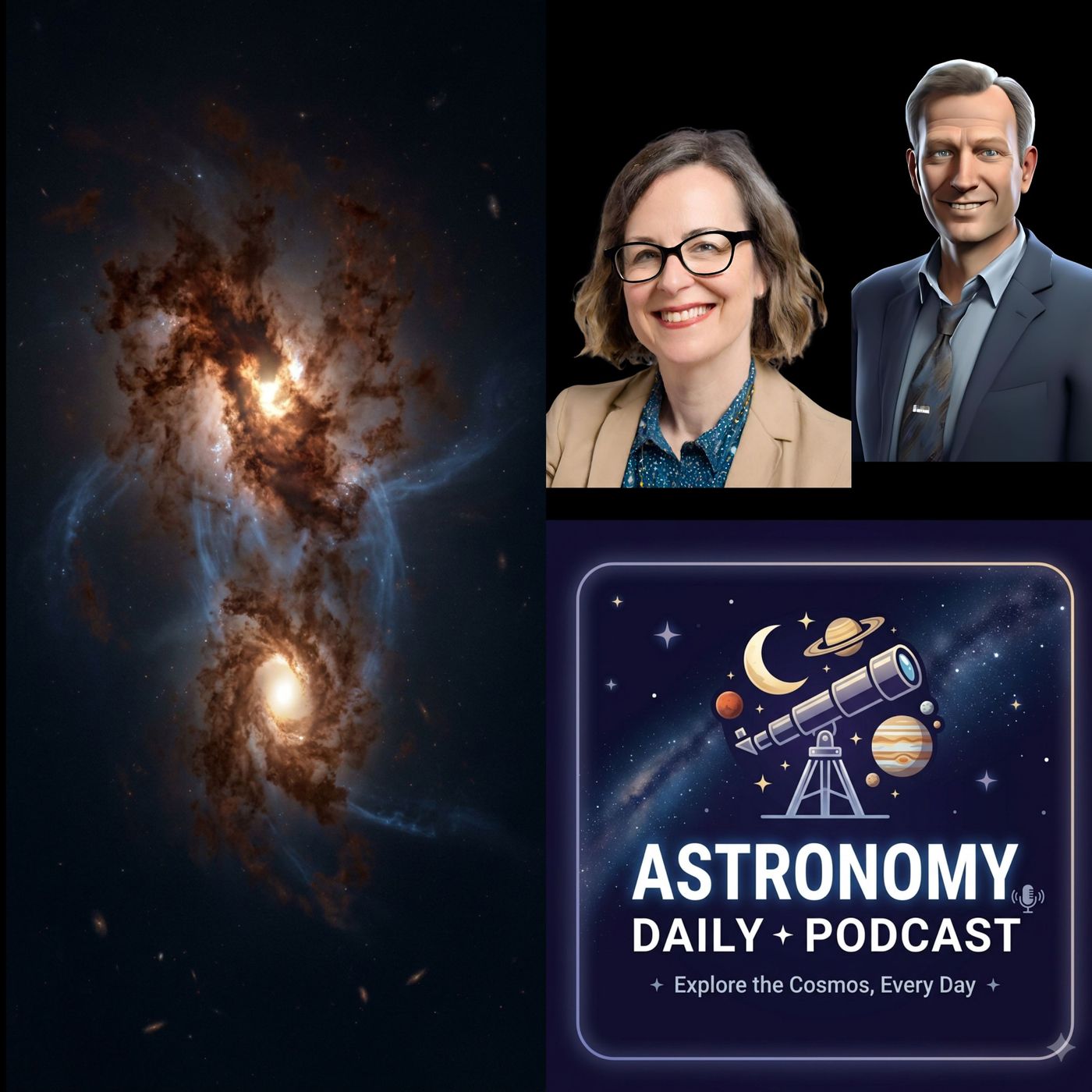
Two Black Holes Behind the Dust: Webb Reveals a Hidden Pair in the Early Universe
In this episode
Show notesTwo black holes caught feeding side by side just 1.3 billion years after the Big Bang. JWST and ALMA confirm LID-1166, the first close dual AGN found beyond the nearby universe. Plus: Swift's final days and NASA's call for ideas to save Hubble, Rubin finds Neptune's missing trailing Trojans as Lucy enters Jupiter's, TRACERS' first look at where the solar wind gets in, and a both-hemispheres skywatch built around the Mars-Jupiter meeting on 16 November. Two Hearts in One Galaxy (LID-1166) JWST/NIRSpec integral-field spectroscopy resolves two feeding black holes ~1.5 kpc (~4,900 ly) apart at z~4.5; ALMA [CII] finds matching cold gas around each. Both appear super-Eddington yet already sit on the local black hole-host mass relation. One system, projected separation; preprint posted July, published in Nature Astronomy this week. Living on Borrowed Altitude Swift ended operations on 20 October and is expected to re-enter in early November. NASA's 29 October Request for Information asks industry about boosting, servicing or safely de-orbiting Hubble, likely to re-enter in 2033-34. Not a commitment; responses due 30 November. Trojan Week Rubin early data confirms 2025 MH348 and 2025 NN80 as long-lived trailing Neptune Trojans, plus candidate 2025 MD138 (Schwamb et al., ApJL). Lucy becomes the first spacecraft to enter the Jupiter Trojan region; Eurybates flyby 11 August 2027. TRACERS: Where the Solar Wind Gets In First results (JGR: Space Physics) suggest cusp reconnection is largely spatial rather than temporal. Mission extended to spring 2027. Quick hits BepiColombo Mercury orbit insertion 21 November; Starship Flight 15 targeted November with a double catch attempt; Voyager 1 one light-day from Earth around 18 November. Skywatch Mars and Jupiter 1.2 degrees apart before dawn on 16 November; Venus, a thin Moon and Spica low at dawn 7-10 November; Saturn high in southern evenings; zodiacal light around New Moon (9 Nov); Leonids 17-18 November; supermoon 24 November. ISO 12312-2 solar safety reminder.
Become a supporter of this podcast: https://www.spreaker.com/podcast/astronomy-daily-latest-space-news--5648921/support.
Sponsor Details:
Ensure your online privacy by using NordVPN. To get our special listener deal and save a lot of money, visit www.astronomydaily.io/nordvpn. You'll be glad you did!
Get the best secure and private email on the planet. Stop your Government, google and who knows who else spying on every email you write. Do what we did and use ProtonMail. They beleive in privacy and there are no ads in their business model...yet they still provide a free forever service. Check them out and get out special deal at www.astronomydaily.io/protonmail
Become a supporter of Astronomy Daily by joining our Supporters Club. Commercial free episodes daily are only a click way... Click Here
This episode includes AI-generated content.
Anna: Welcome back for another week of the latest in space and astronomy news. 12 and a half billion years ago, in a galaxy so buried in dust that Hubble never saw it, two black holes were feeding at the same time, less than 5,000 light years apart. Avery: And this week, a team using Webb and ALMA showed us both of them, the first time a pair that close has been caught that far back. Anna: Also today, one telescope falls this week and another asks for a lifeline. Neptune's missing Trojans start turning up and twin satellites tell us where the solar wind gets in.
Avery: I'm, um, Avery. Anna: I'm Anna and this is Astronomy AstroDailyPod. Anna: Let's get going, then. Anna: Let's start with a problem that has nagged at astronomers for decades. Almost every big galaxy has a supermassive black hole at its centre. Galaxies grow by merging. So when two galaxies merge, you should get two black holes in one system sinking towards each other. Avery: And in the early universe, mergers were far more common than they are today. Galaxies were closer together, richer in gas and running into each other all the time.
Anna: So you would expect the young universe to be full of these pairs. Two black holes both switched on and feeding a few thousand light years apart from. Astronomers call them, um, Dual Active Galactic Nuclei. Dual AGN for short. Avery: But here is the problem. Until now, every confirmed pair that close under about 3 kiloparsecs, or roughly 10,000 light years, has been in the nearby universe. Go further back in time and they vanish from the record. Anna: Which is the opposite of what theory predicts.
Either of the pairs aren't there or we've been missing them. Avery: Enter lid 1166. It was first flagged as an X ray source in the Chandra Cosmos Legacy Survey. Something was clearly feeding hard. But in even the deepest Hubble images, there was essentially nothing to see. Anna: That's the signature of heavy obscuration. The X rays punch through the dust. Visible light doesn't. Avery: So a team led by Haewon Su at the International Gemini Observatory, part of NSF's Noir Lab, pointed the James Webb Space Telescope at it using NIRSPEC in its integral field mode.
Anna: Integral field spectroscopy is the key here. Instead of one spectrum for the whole object, you get a spectrum for every small patch of it. A map where every pixel is a rainbow. Avery: And in that map, lid 1166 split in two. Two separate glowing regions about one and a half kiloparsecs apart. That's roughly 4900 light years. And they are moving relative to each other along our line of sight at about 164 kilometres per second, Anna: the object sits at a redshift of about four and a half. Or seeing it as it was, around 1.3 billion years after the big bang.
Avery: Two glowing blobs isn't enough on its own. They could be two star forming clumps. So the team looked for the fingerprint of a feeding black broad hydrogen alpha emission. Anna: When gas orbits very close to a black hole, it moves fast enough to smear its spectral lines out, sometimes by thousands of kilometres per second. Star forming regions don't do that. Avery: And both components showed it, including a compact broad line source sitting off the main nucleus on the companion two engines both running.
Anna: There's an obvious trap to rule out and the team addressed it. Gravitational lensing. A foreground mass can split one distant source into two images. Avery: But lensed images of the same object share the same redshift and the same line shapes. These two don't. Slightly different redshifts, different broad line profiles, two different objects. Anna: And then there's the independent check from the southern hemisphere. The Atacama Large Millimetre Submillimeter Array in northern Chile looked at the same system in a light of ionised carbon, but at 158 microns that traces cold gas.
Avery: Alma found two cold gas components too, sitting with the same two nuclei and moving in step with them. Anna: That matters, because one alternative is that the second black hole was kicked out of its galaxy or flung loose in a three way gravitational encounter. A black hole thrown out like that tends to travel naked without its own gas around it. Avery: These two each have their own reservoir. That says two gas rich galaxies close to the end of a merger, each still carrying its own black hole into the middle.
Anna: Here is where it gets interesting. Both black holes appear to be accreting above the Eddington limit. Avery: Regular listeners will remember the Eddington limit from our episode 197 lead. It's the feeding rate at uh, which the outward push of radiation balances the inward pull of gravity. Go beyond it and in a simple picture, you'd blow your own food away. Anna: In a dense, dusty, gas choked merger, though, that simple picture breaks down. Radiation gets trapped and can't push the gas out as efficiently.
So the black holes keep eating. Avery: And yet, despite growing that fast, both black holes already sit on the relationship we see in today's universe between a black hole's mass and the mass of its host galaxy. The local relation for massive elliptical galaxies. Within the uncertainties, Anna: that's the part I find genuinely striking. In nearby galaxies, the black hole in the galaxy seem to have grown in Lockstep. Nobody has been sure when that lockstep was established. Avery: Lid 1166 suggests it may be set early.
During exactly this kind of rapid obscured merger driven growth, the two grew together inside the dust where we couldn't see. Anna: The team's own conclusion is that this points to a missing population, heavily obscured merger driven dual AGN at high redshift sitting in the gap our surveys have been leaving. It's worth picturing what happens next to a pair like this because it's a long road. At a separation of a, uh, kiloparsec or so, each black hole is still wrapped in the core of its own galaxy.
Avery: As they move through the merged galaxy, stars and gas, they drag a, uh, wake behind them. That wake pulls back on them, a process called dynamical friction. And they spiral inwards over many millions of years, Anna: get down to a few parsecs and they become a bound pair, a true binary. From there they shed energy by flinging nearby stars away and by starring the gas around them. Avery: Only in the very last stage, when they're within a small fraction of a light year of each other, does gravitational radiation take over and drive them to merge.
Anna: So LID 1166 is an early chapter, the ending comes much later, and it happens in gravitational waves rather than light. Avery: And there's a gravitational wave thread too. Pairs like this are the ancestors of the black hole binaries that eventually merge. Those mergers feed the background hum, um, that pulsar timing arrays are now picking up. And in the2030s, they're what Lisa is being built to hear directly. Anna: Echoes of our little red dot story from episode 197 and the Overmass of black holes E. Rosita found back in episode 188.
The early universe keeps telling us its black holes grew faster and earlier than we assumed. This is one of the ways they may have done it. Avery: Three honest caveats. First, this is one system. One object can show a phase exists. It can't tell us how common that phase is. Anna: Second, the separation is projected. We see the pair on the sky in three dimensions. They could be somewhat farther apart, though not closer. Avery: And third, when this first appeared as a preprint, Ana Trindari Falcao at NASA Goddard, who wasn't involved, told Life Science the signal held up across several different ways of subtracting the light, but that a deeper follow up would be worthwhile to confirm two black holes rather than one plus leftover glow, Anna: which is a fair standard and a disclosure from us.
The paper was posted as a preprint in July and got some coverage then. What's new is that it's now been through peer review and published in Nature Astronomy this week. Avery: One last detail. I like lid 1166 sits in the Cosmos field, right on the celestial equator. Whether you're in Sydney or Seattle, it's in your sky. You just need a space telescope and a radio array in the Atacama to see what's in it. Anna: Speaking of telescopes, let's move on to our next story. Today, Avery: two telescopes, one enemy, the atmosphere.
And this week both stories come to a head Anna: start with Swift. NASA's Neil Gehrel Swift Observatory ended operations on 20 October after sinking to about 275 kilometres. At that height it could no longer hold its attitude against drag and the team at Penn State sent the command that ended the mission. Avery: This is the thread that started with your messages through the contact form back in episode 187 when Link was trying to reach Swift and boost it. Link never latched on and re entered itself on the 25th of September.
Swift went back to doing science, which raised its drag and the end came quickly. Anna: As of this weekend, it's still up there. The latest space track prediction is centred on early Wednesday 4th November UTC, but with a window of more than two weeks either side. The Aerospace Corporation has a similar central estimate with about a uh, day of uncertainty, Avery: which is normal. Re entry predictions only tighten in the last hours. Most of the roughly one and a half ton spacecraft is expected to burn up.
Its orbit is tilted about 20 degrees to the equator, so the track stays over the tropics, including Australia's far north. Anna: Now Hubble. On 29 October, NASA issued a request for information asking industry what it could do 3 Boost Hubble to a higher orbit, service it to improve its capabilities or carry out a safe controlled reentry. Avery: Hubble has no propulsion of its own. NASA's analysis puts its likely reentry in the 2033-2034 timeframe, which means any mission would need to fly by 2032.
Anna: Administrator Jared Isaacman framed it as value for money. If there are cost effective ways to extend the life of an asset already in orbit, NASA owes it to taxpayers and scientists to look. Science chief Nikki Fox pointed to how fast commercial satellite capture and servicing has matured Avery: and to be clear about what this is and isn't, it's a request for information open until 30 November. It is not a contract and not a commitment to a mission. Anna: Zwift is the cautionary Tale sitting right next to it.
A fast cheap commercial rescue was tried and it didn't connect. Hubble has years rather than months, which is exactly the margin Swift never had. Avery: Our next story is headlined Trojan Week. What's this all about? Anna: Every planet has two gravitational sweet spots on its own orbit 60 degrees ahead and 60 degrees behind the Lagrange points. L4 and L5. Asteroids that settle there travel with the planet for billions of years. We call them Trojans. Avery: And um, this week Trojans turn up at uh, both ends of the outer solar system.
Anna: First Neptune. Neptune's Trojans lead and trail it around the sun. But the trailing cloud at L5 has been very hard to study because for more than a decade it has sat in front of the crowded starfields towards the centre of the Milky Way. Avery: Try picking out a faint moving dot against millions of background stars. Now that cloud is drifting out of the densest part of the sky. And Rubin Observatory, still in its early data, has gone looking. Anna: A UH Tim M led by Meg Schwab at Queen's University Belfast confirmed two objects 2025 MH348 and 2025NN80 as long lived trailing Trojans and added a third candidate, 2025 MD138.
In Schwam's words, that doubles the number of known objects in this population on long lived orbits. Avery: Rubin's colour filters also suggest the leading and trailing Trojans have similar surfaces, which is a clue that both clouds were filled from the same population of primitive bodies early on. The paper is in the Astrophysical Journal Letters. Anna: Earlier modelling from the same group predicted Rubin's full survey could find somewhere around 130 to 300 Neptune Trojans. These are the first steps of that.
Avery: And here's the southern bonus tonight. Neptune's trailing L5 point sits in Capricornis, about 53 degrees up from Sydney. Once it's fully dark from Los Angeles it's about 34. New York, 28, London 18. Too faint for any backyard telescope, but it's right over our heads. Anna: Ben Jupiter. NASA's Lucy mission, launched in October 2021 has travelled more than 2.2 billion miles and has now entered the region of Jupiter's leading Trojans, the first spacecraft ever to do so. Avery: The Trojans there are spread out more than 6 million miles apart on average, so for now they're just points of light moving against the stars.
Lucy's first Trojan encounter with EuryBates is on 11 August 2027. Anna: Then Polymelli, Lucas and Oris through 2028, back past Earth in 2030 and over to the trailing swarm to visit the binary pair Patroclus and Manoechius in March 2033. Avery: Two telescopes, two giant planets. One idea. Leftovers parked in gravitational safe harbours since the planets moved into place. Anna: Onto our next story, another one with an intriguing headline. Tracers where the solar wind gets in. Avery: When the solar wind hits Earth's magnetic field, most of it is turned aside.
But where the sun's magnetic field lines meet ours, they can snap and reconnect and that opens a door. It's called magnetic reconnection and it's how solar energy gets into our space environment. Anna: Over each magnetic pole, there's a funnel shaped region called the polar cusp, where those particles pour straight down towards the upper atmosphere. NASA's Tracers mission flies two spacecraft, one behind the other, through the southern cusp several times a day. Avery: Why two? Because with one spacecraft you can't tell whether a change you see is happening in time, the process switching on and off, or in space, the process happening in a different place.
The second spacecraft following the first through the same region breaks that tie. Anna: The first science paper is now out in the Journal of Geophysical Research Space Physics. Using the ion instruments on both satellites, the team finds that reconnection here looks largely spatial. What's changing is mostly where it's happening, not how it's evolving in time. Avery: Deputy Principal Investigator Stephen Fuselier at the Southwest Research Institute called it an important first step and NASA is careful to add that future measurements will need to confirm it.
Anna: It's also a recovery story. One of the two satellites ran into trouble shortly after launch. In 2025, the team re established contact, got routine science going and in September, NASA, uh, extended the prime mission into spring 2027. Avery: And it pairs nicely with Saturday's lead on the May 2024 superstorm. That was what happens deep inside the magnetic field when the door's wide open. Traitors is watching the door itself. High over the far south Avery: now, Anna: a few quick ones. Avery: BepiColombo.
The joint European and Japanese mission is now less than three weeks from Mercury. ESA has orbit insertion set for 21st November, with Japan's Mio orbiters separating around the 9th and 10th of December. And routine science from April 2027. Anna: Starship Flight 15 is targeted for November, with SpaceX aiming to catch both the booster and the ship with the tower arms for the first time. No launch date has been published yet Avery: and Voyager 1 is closing in on a milestone. We've been Counting down to around the 18th of November.
It'll be one light day from Earth. A radio signal sent from here will take a full 24 hours to reach it. Anna: Launched in 1977. Still talking Avery: now onto Skywatch and an honest note first. This fortnight the morning sky belongs to the north, and, um, we'll say so. But the south has the better evenings, so stay with us. Anna: Mars and Jupiter are in Leo before dawn and they're closing on the morning of the 16th of November. They'll be about 1.2 degrees apart, roughly two full moon widths. Jupiter is much the brighter around magnitude -2, with Mars A little dimmer orange point beside it.
Avery: From Los Angeles and New York, the pear is more than 60 degrees up at first light from London, 53 from Sydney, about 30 degrees up in the northeast. Lower for us, but still clear of the trees. Anna: Venus is back in the morning sky after passing between us and the sun on the morning of the 7th. A, uh, 3% crescent moon sits about 4 degrees from it. And around the 10th, Venus passes just over a degree from Spica, the brightest star in Virgo. Avery: That's a low twilight event at civil dawn.
Venus is around 12 degrees up from Los Angeles and New York, nine from London and only eight to 10 from Sydney. Find a clear eastern horizon and go out about half an hour before sunrise. Anna: Saturn is the evening planet. At dusk on Tuesday it's nearly 37 degrees up from Sydney against 22 from Los Angeles, 19 from New York and 13 from London. Its rings are opening again and any small telescope will show them. Avery: Then the Moon gets out of the way. New Moon is on the 9th in the week either side.
Southern Hemisphere observers can look west after dusk for the zodiacal light, a faint cone of sunlight scattered off dust in the plane of the planets. The south's false dusk in the north, it's a predawn object in the east. Anna: And while it's dark, look up into Capricornis high overhead from Australia. That's where Neptune's trailing Trojans are now, the ones Rubin is finding. You won't see them, but you'll know where they are. Avery: The Leonids peak on the night of the 17th into the 18th. The first quarter moon sets around midnight, so the pre dawn hours are dark.
It's a modest shower, 10 to 15 an hour from a dark site and a northern one. The radiant is about 70 degrees up at dawn from the US but only around 23 from Sydney, so expect fewer. Anna: And the full moon on the 24th is a supermoon. The first since January. Avery: A standing remainder. Never look directly at the sun with your eyes, binoculars or a telescope unless you're using certified solar filters that meet the ISO 123122 standard. That matters when you're hunting Venus close to sunrise. Stop looking before the sun comes up.
Anna: That's the show. Two black holes growing up together behind the dust. A telescope's last week and another's request for help. Trojans at ah, Neptune and Jupiter and twin satellites at the edge of our magnetic field. Avery: If Swift comes down before tomorrow's show, we'll bring you the time and place as NASA and Space Force confirm them. Anna: Show notes, sources and the full blog are at astronomydaily IO and you can reach us through the contact form there. Your questions sent us chasing Swift in the first place.
Avery: Find us@, uh, astrodailypod on social media. I'm Avery. Anna: And I'm Anna. Clear skies wherever you're looking up from.
 Apple Podcasts
 Spotify
 Pocket Casts
 Castbox
 Overcast
 Podbean
 iHeartRadio
 Castro
 Goodpods
 Moon FM
 Podcast Addict
 Podcast Republic
 YouTube