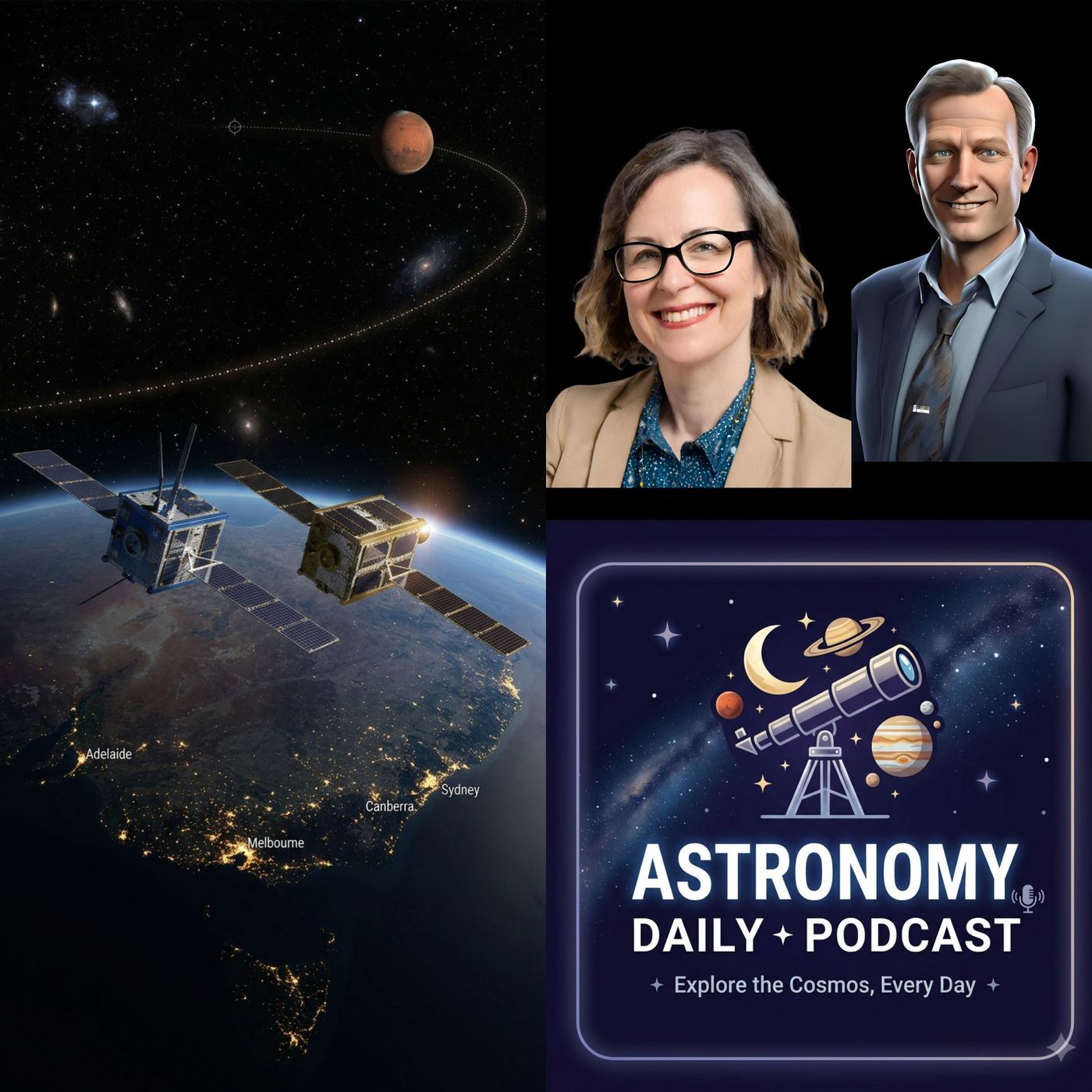
Escapade’s Double Slingshot: Mars-Bound Probes, Missing Oxygen and Black Holes in Pants
In this episode
Show notesESCAPADE's double slingshot over Australia NASA's twin ESCAPADE spacecraft, Blue and Gold, will each fly a powered Earth flyby on their way to Mars: the first around 5 a.m. EST on Saturday 7 November, the second around 6 a.m. EST on Monday 9 November. Each fires its engine for about nine minutes at closest approach, a manoeuvre NASA says no Mars-bound spacecraft has flown successfully before. The burns happen over southern Australia, starting 8:51 p.m. AEDT on the 7th and 9:51 p.m. AEDT on the 9th, and the spacecraft may be visible there through telescopes. Western US observers get their best chance between midnight and 2 a.m. PST. Arrival at Mars: 7 and 9 September 2027. Where did the oxygen go? Hubble's GLOW project (McQuinn et al., The Astrophysical Journal, published 2 November; preprint since August) measured oxygen in 37 nearby dwarf galaxies and found they keep only 4–25% (about 11% on average) of the oxygen their stars made, nearly all of it in gas. Simulations predict several times more. Supernova-driven winds are the likely culprit; where the oxygen ended up is still unknown. Gas data included CSIRO's Australia Telescope Compact Array. CHAPEA 2: a year on a pretend Mars NASA's second CHAPEA crew, Ross Elder, Ellen Ellis, Matthew Montgomery and James Spicer, left the 3D-printed Mars Dune Alpha habitat at Johnson Space Center on 31 October after 378 days, including communication delays of up to 22 minutes. An integrated HERA-plus-CHAPEA study is planned for 2027. Can a black hole split in two? A theory paper in Physical Review D (Cacciapaglia, Del Piano, Sannino & Vellucci, 22 October; preprint June) finds a split is thermodynamically allowed only, possibly, for black holes spinning near the maximum rate. The splitting process itself remains unknown, and no split has been observed. Quick hits Swift's final re-entry (see episode for status at recording); Starship Flight 15 targeted 12 November on an FAA planning slide, no SpaceX date yet; BepiColombo Mercury orbit capture 21 November; Voyager 1 one light-day from Earth around 18 November. Skywatch ESCAPADE telescope challenge over Australia (Sat 8:51 p.m. and Mon 9:51 p.m. AEDT); New Moon 9 Nov; Taurid fireballs; Mars and Jupiter closing to about 1.2° on 16 Nov (UT); thin crescent Moon under 1° from Venus around 10:45 UT on 7 Nov, best from eastern North America; Venus about 1.2° from Spica on the mornings of 9–10 Nov; Mercury at greatest western elongation 20 Nov. Never look at the Sun without ISO 12312-2 certified protection. Sources NASA ESCAPADE blog: Twin ESCAPADE spacecraft to slingshot past Earth (2 Nov 2026) — https://science.nasa.gov/blogs/escapade/2026/11/02/nasas-twin-escapade-spacecraft-to-slingshot-past-earth-on-way-to-mars/ NASA SVS ESCAPADE flyby star charts — https://svs.gsfc.nasa.gov/15114/ JPL Horizons System — https://ssd.jpl.nasa.gov/horizons/app.html#/ UC Berkeley ESCAPADE mission timeline — https://escapade.ssl.berkeley.edu/timeline-news Blue Origin: New Glenn launches NASA's ESCAPADE (13 Nov 2025) — https://www.blueorigin.com/en-US/news/new-glenn-launches-nasa-escapade-lands-fully-reusable-booster NASA: Hubble uncovers case of missing oxygen in nearby dwarf galaxies (2 Nov 2026) — https://science.nasa.gov/missions/hubble/nasas-hubble-uncovers-case-of-missing-oxygen-in-nearby-dwarf-galaxies/ McQuinn et al., GLOW II: A Census of Oxygen in Low-Mass Galaxies, ApJ, DOI 10.3847/1538-4357/ae93a6 (preprint arXiv 2608.07665) — https://arxiv.org/abs/2608.07665 NASA: CHAPEA crew 'returns' to Earth (31 Oct 2026) — https://www.nasa.gov/image-article/nasas-chapea-crew-returns-to-earth/ University of Southern Denmark: Can a black hole split in two? — https://www.sdu.dk/en/om-sdu/fakulteterne/naturvidenskab/nyheder-2026/black-hole-in-two Cacciapaglia, Del Piano, Sannino & Vellucci, Phys. Rev. D 114, 084072 (22 Oct 2026), DOI 10.1103/cx69-t466 —...
Anna: This Saturday night, somewhere above southern Australia, a spacecraft about the size of a refrigerator will fire its engine for nine minutes and throw itself at Mars. Two nights later, its twin will do exactly the same thing. No Mars bound spacecraft has ever pulled this off before. Avery: And if you have a telescope and a clear sky, you might actually be able to watch it happen. I'm Avery. Anna: And I'm Anna and this is Astronomy daily for Thursday 5th November 2026. Coming up, why small galaxies can't hold onto their oxygen.
Four people walk out of a year on a pretend Mars and whether a black hole could ever split in two. Avery: Plus the Latest on um, SWPP's final plunge and a sky full of morning planets. Let's go. Anna: Let's start with a mission that took a very strange road to Mars. Escapade, which stands for Escape and Plasma Acceleration and Dynamics Explorers, is a pair of small NASA spacecraft nicknamed Blue and Gold, after the colours of the University of California, Berkeley, which runs the mission. Rocket Lab built them Avery: and they launched almost a year ago on, um, 13 November 2025, on the second flight of Blue Origin's new Glenn rocket.
Which raises the obvious question, Anna. Uh, if they launched a year ago, why are we only now talking about them heading to Mars? Anna: Because when they launched, Mars was in the wrong place. Normally Mars missions launch in a window that opens about every 26 months when Earth and Mars line up. So the trip is short and cheap. On fuel Escapade launched when Earth and Mars were on opposite sides of the sun. Avery: So instead of heading out, they waited. Anna: They waited in a very clever way. The two spacecraft flew out to a region beyond Earth called the Sun Earth Lagrange Point 2, about 1 1/2 million kilometres away, and traced a kidney bean shaped loop around it.
That loop was designed to bring them back to Earth at exactly the moment the planets line up again. And that moment is now. Avery: Lagrange point 2 will sound familiar to some listeners. It's the same neighbourhood where the James Webb Space Telescope lives. A spot on the far side of Earth from the sun where the poles of the two balance out so a spacecraft can hang around without much fuel. Anna: And the launch itself made a little history. That November flight was the first time Blue Origin landed a new Glenn first stage booster on a ship out in the Atlantic.
It was also Rocket Lab's first interplanetary spacecraft. So a lot of firsts were riding on these two small probes before they even started the hard part, Avery: small is the word too. Each spacecraft is about the size of a Refrigerator. And the whole mission has been described as costing under US$80 million, which is extraordinarily cheap for a trip to Mars. Anna: So here's what happens. The first spacecraft makes its closest approach to Earth around 5am Eastern Time on Saturday 7th November. The second follows two days later, around 6am Eastern on Monday the 9th.
Avery: As each one swings past Earth's gravity, speeds it up and bends its path toward Mars. That part is an ordinary gravity assist. Plenty of missions have used them. What's new is that at uh, closest approach, each spacecraft will also fire its own engine for about nine minutes. NASA calls this a Trans Mars injection burn. Anna: This is what engineers call a powered flyby or an Oberth manoeuvre, after the rocket pioneer Herman Oberth. And NASA says no Mars bound spacecraft has ever successfully flown one.
Avery: The reason it's worth doing is a neat bit of physics. A kilogramme of fuel burned when you're moving fast gives you more useful energy than the same kilogramme burned when you're moving slowly. And a spacecraft is never moving faster than at uh, the bottom of a gravity well right at closest approach. So you get the most out of your engine by firing. Exactly. There's. Anna: How much of a push are we talking about? Avery: According to NASA, the burn adds more than 1,000 miles an hour, taking each spacecraft from about 6.3 to about 6.7 miles per second.
That's roughly 10.1 to 10.8 kilometres per second. NASA's own comparison is that at that speed you could cross the United States from Washington to San Francisco in under seven minutes. Anna: And then it's a ten month cruise. Blue and Gold should arrive at Mars on the 7th and 9th of September next year. Avery: Now here's the part I love. Both burns happen as the spacecraft fly over southern Australia. NASA's own timing puts the first engine burn starting at 8:51pm Australian Eastern Daylight Time on Saturday the 7th and the 2nd at 9:51pm on Monday the 9th.
Anna: So for once the dramatic bit of an American Mars mission happens over our heads in the evening at a civilised hour. Avery: It does. Let's be honest about what you'd actually see though. At um, closest approach, the spacecraft will be somewhere between about 1,000 and 1,800 kilometres up. That's higher than most satellites. They're small and NASA says you'll most likely need a telescope where they'll look like faint points of light drifting slowly against the stars. Not a fireball, not, uh, a streak.
Anna: And there's a practical wrinkle we checked On Saturday the 7th at 8:51pm Eastern Daylight Time, the sky over Sydney has only just become properly dark. Nautical twilight ends there around 8:28. In Melbourne it's still twilight until just after 9 and in Adelaide until about 9:20. Monday's Burn an hour later falls in a darker sky across the southeast. Avery: For our, uh, North American listeners, you get a different view in the hours before each flyby. The spacecraft should be visible from the western United States, where NASA says they'll be best between midnight and 1am Pacific time on the 7th and between 1 and 2am Pacific on the 9th before they slip below the horizon about an hour ahead of the burn.
Anna: If you want to try, NASA points people to JPL's Horizons system, which will give you exact coordinates for your location. And NASA's Scientific Visualisation Studio has star charts. We'll link both in the show notes. Avery: There are two reasons this matters beyond a pretty manoeuvre. The first is about Mars itself. Once there, Escapade will be the first mission to fly two spacecraft in formation around Mars. Together they'll measure how the solar wind, that million mile an hour stream of charged particles from the sun, strips away the Martian atmosphere.
With two spacecraft, you can tell whether a change happened over time or just over distance, something a single orbiter can't separate. Anna: And Mars lost most of its atmosphere over billions of years. So this goes right to the question of how a, uh, once wetter planet dried out. Avery: The second reason is about how we get to Mars at all. If this works, it shows you don't have to wait for the 26 month window to launch. You could launch when a rocket is available, park your spacecraft near Earth and leave when the planets line up.
Escapade's principal investigator, Rob Lillis, has described it as a way to queue spacecraft up. Anna: And the waiting wasn't wasted on its loop. Escapade flew through a distant stretch of Earth's magnetotail, the part of our magnetic field the solar wind stretches out behind the planet. NASA says no spacecraft had directly explored that region before and that the team saw interesting activity and structure there. Avery: They haven't published those results yet, so we'll report what they found when they do.
For now, the big date is Saturday night over Australia and a few days afterwards the team will know how well both spacecraft are aimed for Mars and plan the course corrections to fine tune the trip. Anna: We'll bring you that when it comes. Fingers crossed for two clean burns. Our second story is a, uh, cosmic missing persons case. Except the missing person is an element. Oxygen. Avery: This one comes from the galaxies losing oxygen via WNT project, or GLOW, led by Kristen McQuinn of the Space Telescope Science Institute and Rutgers University.
The paper was published this week in the Astrophysical Journal. An earlier version had been circulating, uh, as a preprint since August. Anna: The idea is beautifully simple. Stars make oxygen. And if you know how many stars a galaxy has made over its history, you know roughly how much oxygen it should have made. Then you go and count how much is actually still there. Avery: The team did that for 37 nearby dwarf galaxies, all within about 20 million light years, and all close enough for Hubble to pick out individual stars.
They worked out each galaxy's star formation history from Hubble images, then looked for oxygen in three places. In the stars, in the gas and locked up in dust. The gas measurements used radio data from the Very Large Array in New Mexico and from CSIRO's Australia Telescope Compact Array near Narrabri. Anna: And what did they find? Avery: That these galaxies have kept between about 4 and 25% of the oxygen their stars produced. The average is about 11%. And nearly all of what's left is in the gas, not the stars.
Anna: So roughly nine tenths of it is gone. Avery: Gone from the galaxy itself. Yes. The explanation is supernovae. When massive stars explode, they drive winds out of a galaxy. And a small galaxy has a shallow gravitational well, so it can't hold onto that material. The surprise is how efficient those winds are. Computer simulations of galaxy formation predict retention fractions several times higher than what glow measured. Even though those same simulations get the overall chemistry of galaxies about right.
Anna: Which is a nice reminder that matching one summary number doesn't mean your model has the physics right. Avery: Exactly. There's a subtle environmental twist as well. The dwarfs living near bigger galaxies in denser neighbourhoods tended to hold onto more oxygen. The authors call that trend tentative. Anna: Regular listeners might hear an echo here. Back in episode 199, we covered the Andromeda superbubble study, where supernovae were enough to keep a big galaxy's gas stirred up. Same engine, different outcome.
In a big galaxy, supernovae churn the gas. In a small one, they throw it out. Avery: And the honest, open question, which the paper is clear about, is where the oxygen ended up. Some is detected in the halos of gas around dwarf galaxies, but not nearly enough to account for all of it. Whether the rest is lingering nearby or has escaped into intergalactic space entirely, nobody knows yet. Anna: A final note for southern listeners. Several of the galaxies in the sample are southern sky objects including NGC 3109, NGC 5253 and IC 5152.
Next steps for the team include Roman, which will search for even smaller fainter dwarves. Avery: Next four people who have just come home from Mars without ever leaving Texas. Anna: On Saturday 31 October, the crew of NASA's second Chapea mission, that's the Crew Health and Performance Exploration Analogue, walked out of their habitat at A.H. johnson Space Centre in Houston after 378 days. Inside Avery: the crew were Commander Ross Elder, Medical Officer Ellen Ellis, Science Officer Matthew Montgomery and Flight UH engineer James Spicer.
They went in on the 19th of October last year. Anna: Home for that year was Mars dune alpha, a uh, 3D printed habitat of about 160 square metres. Roughly the floor area of a modest family house for four people. For more than a year. Avery: Inside they lived the way a Mars surface crew might. They did simulated Mars walks, grew crops, maintained the habitat and its equipment, ran science, exercised and handled their own medical checks. And every message to and from Earth came with a built in delay of up to 22 minutes each way.
The kind of lag a real Mars crew would face. At one stage the crew also went through a simulated two week communications blackout. Anna: That delay is the bit people underestimate. You can't ask mission control a quick question. By the time the answer comes back you've had to solve the problem yourself. Avery: Which is exactly what CHEA is meant to study. It isn't testing hardware so much as people. How crews cope with isolation, confinement, limited supplies and communication delays and how that affects their health and their performance.
NASA says the data will feed into things like food system design, how uh crew time is allocated and how much bandwidth deep space missions need on the Deep Space Network. Anna: And the Deep Space Network is a nice place to drop in an Australian connection because one of its three complexes is at Hidbinbilla outside Canberra, run for NASA by csiro. Any real crew on Mars would be talking to Earth through dishes like those. Avery: The crew now face about two weeks of post mission evaluations. The first Chapa crew came out in July 2024, also after 378 days.
What comes next is an integrated study planned for 2027 that links Chapa with NASA's Her Habitat. Hera placed the spacecraft and CHAPA placed the base on the surface. Anna: NASA hasn't said when the results from this second mission will be published or fixed a start date for that combined study. So as ever watch this space. Avery: Next up. I know our audience loves a good Black hole story and, um, you have a good one for us today, Anna. Anna: Our last story is pure theory and it comes with an unusual Black Holes Wearing Pants.
Avery: I promise that's the actual title. The paper's called When Black Holes Admit Pair of Pants topologies by Giacomo Caciopalli, Manuel del Piano, Francesco Sannino and Vania Velucci, mostly from the Quantum Field Theory Centre at the University of Southern Denmark. It was published in Physical Review D on 22 October after appearing as a preprint in June. Anna: We know black holes merge. Two go in, one comes out and we hear the gravitational waves. The question here is whether the reverse could ever happen.
Could one black hole become two? Avery: Normally, the answer is no and, and the reason is entropy. A black hole has entropya measure of how many microscopic arrangements could produce the same outside appearance. For a black hole that isn't spinning, splitting into two smaller ones would lower the total entropy. And, um, the second law of thermodynamics says that left to itself, total entropy doesn't go down. Anna: Joe, where is the loophole Avery: spin? A, uh, rapidly rotating black hole stores energy in its rotation and that changes the bookkeeping.
The team found that for fast spinners, a split might not break the entropy rule. But there's a second condition. The two new black holes have to be able to fly apart rather than immediately fall back together. When the team added that requirement, the window almost closed again. It's left open, only possibly for black holes spinning close to the maximum rate physics allows. Anna: And the pants? Avery: If you draw the black hole's boundary, its event horizon as it moves through time, a split would look like one tube developed, dividing into a waist and two legs.
Mathematicians call that shape a pair of pants. Anna: Here's our caveat, and it's an important one. This paper works out when a split would be allowed. It does not show how a split would actually happen. In the author's own diagram, the crotch of the pants, the moment of splitting, is labelled unknown dynamics. Avery: And there's no observational evidence that any black hole has ever split. The team suggests that small primordial black holes from the early universe would be more prone to it than big astrophysical ones, and that gamma ray telescopes like Fermi might one day search for signs of tiny fragments.
San Eno says they can't yet put a probability on it because it depends on how gravity behaves beyond Einstein's theory. Anna: So, not impossible, not observed and not yet explained, which is a perfectly good place for a theory paper to be. Now let's move on to a few quick hits. Avery: First, a farewell. NASA's Neil Garrell Swift Observatory has re entered Earth's atmosphere almost 22 years after launch. Swift Re entered Earth's atmosphere at 1239 GMT today over northern Sumatra. According to US Space Force data, Swift was designed for a two year mission.
It caught more than 2,000 gamma ray bursts and its archive has been cited in thousands of papers. It was the subject of our Listener driven Link Rescue story and it's been a pleasure to follow it to the end. Anna: Starch Flight 15 is now showing on a US air traffic planning slide for Thursday 12 November, a few days later than the 8th. On earlier slides, SpaceX hasn't announced a date and doesn't yet have a launch licence, so treat that as a target, not a schedule. The headline goal remains the first attempt to catch both stages with the launch tower Avery: and two dates for the diary.
BepiColombo is due to be captured into orbit around Mercury on 21 November and around the 18th. Voyager 1 will become the first spacecraft to sit one full light day from Earth. A radio Signal will take 24 hours to reach it. Anna: Time for the sky and we'll start with this weekend's headline be Because Escapade gives Australia a Rare Evening Spacecraft Spotting challenge, the engine burns start at 8:51pm Eastern Daylight Time on Saturday and 9:51pm on Monday. Remember, it's a telescope job, not a naked eye one.
Avery: And um, the timing helps because the moon is out of the way. New moon is on Monday the 9th, so the evenings this weekend are dark, which is also good news for meteor watchers. Anna: That's the Taurids. The southern taurids peak around the 4th and 5th of November, with the northern taurids following around the 12th. Rates are low, maybe 5 an hour from a dark site. But the Taurids are known for occasional bright fireballs, so they're worth a look. The radiant in Taurus climbs to about 43 degrees from Sydney, around 60 degrees from New York and almost 70 from Los Angeles, so northern observers get it a bit higher, but everyone is in the game Avery: now the mornings.
This is where most of November's action is and it favours the north this time. Mars and Jupiter are drawing together in LEO this morning they're about four and a half degrees apart. By our calculation they close to a minimum of about 1.2 degrees on 16 November, around 2am M Universal Time. Anna: Quick note on that, you'll see some listings say they pass within less than a degree Our own calculation gives 1.2 degrees, and they stay within about 1.3 degrees from the 14th to the 17th. So there's no wrong morning to look.
Jupiter is the brighter of the 2, about magnitude -2, with Mars a ruddy magnitude -0.7. Avery: Here's the hemisphere contrast. 45 minutes before sunrise on the 15th, the pair is about 32 degrees up from Sydney in the northeast. From Los angeles, they're nearly 70 degrees up from New York, about 64, and from London, um, about 53. So northern listeners kept them high and easy, while from Australia, they sit lower but still clear of the horizon murk Anna: lower down. Venus is climbing out of the morning twilight.
On Saturday morning the 7th, a very thin crescent moon, only about 5% lit, sits close to Venus. Our calculation puts the two closest under a degree apart around 10:45 universal time on the 7th. That's about 5:45am M in New York before sunrise. So the eastern US and Canada get the tightest pairing. Look low in the east southeast with a clear horizon Avery: from Australia. The Moon and Venus are several degrees apart that morning and very low, around 5 degrees up from Sydney, 45 minutes before sunrise.
Binoculars will help, but please put them away before the sun comes up. Anna: Then Venus slides past the star Spica, uh, the brightest in Virgo, coming within about 1.2 degrees on the mornings of the 9th and 10th. Again, it's low, so you'll need a clear eastern view. Avery: And a reminder of our standing rule. Never look at the sun and never point binoculars or a telescope anywhere near it without proper protection for direct solar viewing. That means certified filters or eclipse glasses that meet the international safety standard ISO 12312 part 2.
Ordinary sunglasses are not safe. Anna: And one last thing. Mercury passes between Earth and the sun today, so it's out of sight for now. But it swings back into the morning sky and reaches its greatest western elongation on 20 November. By then, there'll be four planets in the predawn Mercury, Venus, Mars and Jupiter. More on that closer to the date. Avery: And that's Astronomy AstroDailyPod for today. We had escapades double slingshot over Australia this weekend. The dwarf galaxies that, uh, lost most of their oxygen.
Chapea's crew back on solid Texan ground. Plus black holes that might, just might, wear pants. And the demise of Swift. Anna: Show notes, sources and links, including NASA's escapade star charts are at astronomydaily.IO you can find us on social media astrodaily pod. And if you have a question you'd like us to tackle on air, use the contact form on the website. Some of our best segments have started there. Avery: Wherever you are, north or south, clear skies. I'm Avery. Speaker C: And I'm, um. Anna: Anna.
See you Speaker C: tomorrow. : Astronomy Day. Stories be told,
love.
Story.
For soul.
 Apple Podcasts
 Spotify
 Pocket Casts
 Castbox
 Overcast
 Podbean
 iHeartRadio
 Castro
 Goodpods
 Moon FM
 Podcast Addict
 Podcast Republic
 YouTube