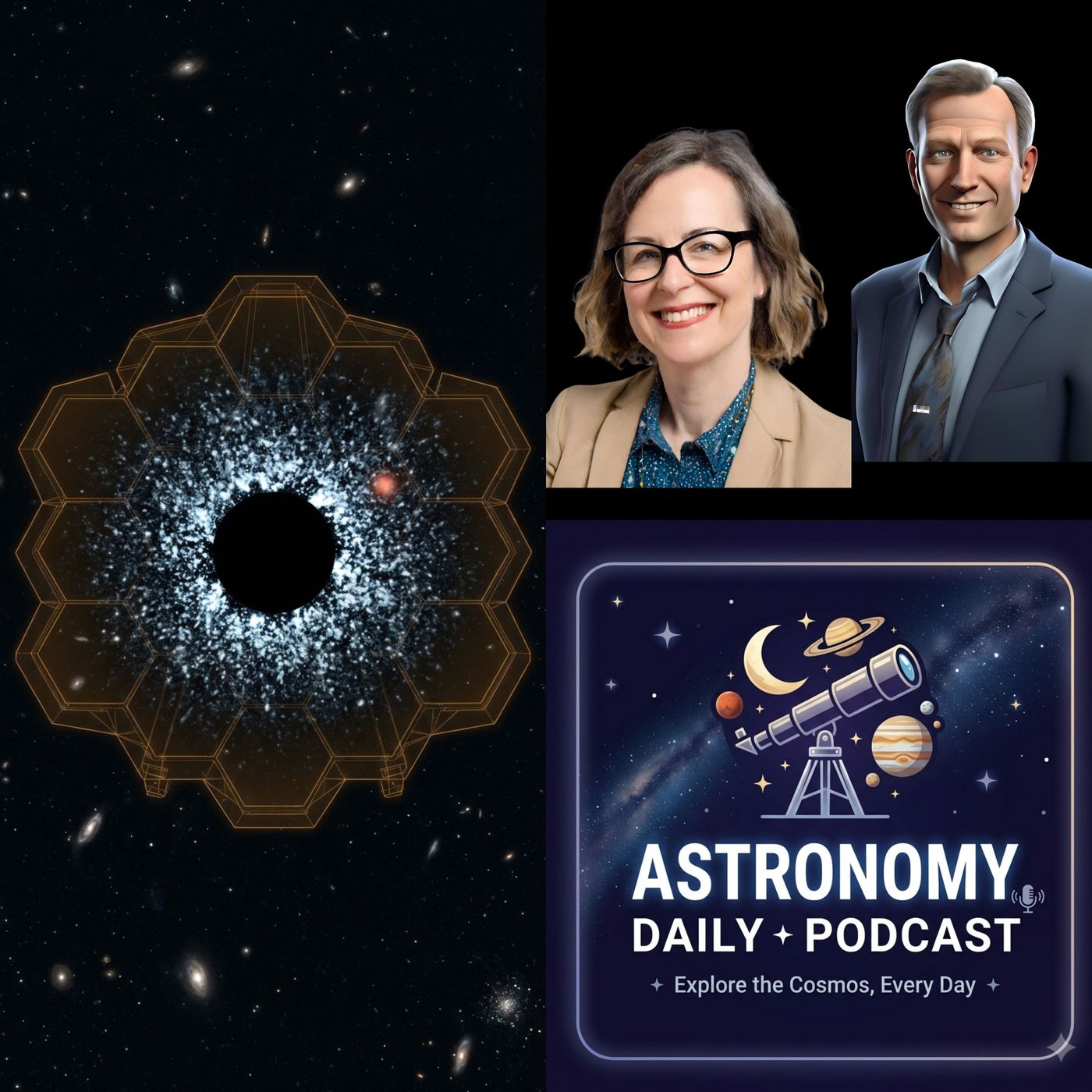
Webb’s Digital Twin: A Hidden Planet, Ancient Stars and China’s Moon Plan
In this episode
Show notesA Northwestern-led team builds a physics-based digital twin of the James Webb Space Telescope's coronagraph and recovers the giant planet 51 Eridani b in two-year-old data where standard processing could not see it. Plus VVV CL001, a dust-hidden cluster near the Milky Way's core dated at 13.4 billion years; China's most detailed account yet of its two-launch crewed Moon landing plan; and the flare alert system that tells sounding rockets exactly when to launch, as sunspot region AR4566 turns magnetically complex. The Planet in the Glare (lead) Ferrer-Chavez, Wang, Bouman, Freeman, Pueyo et al., Nature, 4 Nov 2026, DOI 10.1038/s41586-026-11213-z. FLIP (Physics-based Learning for Imaging Planets) models JWST/NIRCam coronagraph optics as a digital twin and subtracts simulated starlight. Tested on HIP 65426, 51 Eridani and TYC 5899: sensitivity improved 2–15×; 51 Eri b recovered at >5σ in F430M (CO₂ band) data where standard processing failed. Not a new planet; three-star demonstration; picometre-stability relief for the Habitable Worlds Observatory is a prospect, not yet shown. VVV CL001: the oldest cluster in the Galaxy? Olivares Carvajal, Zoccali et al., accepted to A&A, arXiv 2610.27969 (posted 20 Oct 2026). Age 13.4 ± 0.4 Gyr from Magellan/FourStar and Hubble photometry; [Fe/H] ≈ −2.2; ~7.3 kpc in the bulge. ~1 Gyr additional systematic from distance; Ton 2 dated at 13.6 Gyr — a strong candidate, not a settled record. China's crewed Moon landing plan Wang Xiang, 7th Manned Space Symposium, Beijing, 31 Oct 2026. Two Long March 10 launches; Lanyue lander and Mengzhou crew ship rendezvous in lunar orbit; crew of three, two land, rover on first landing. No new dates; target remains before 2030. Catching a flare in the act Early flare alert system, The Astrophysical Journal, 4 Nov 2026, DOI 10.3847/1538-4357/ae95fd. Enabled FOXSI-4 and Hi-C Flare to launch into an M-class flare on 17 Apr 2024 and FOXSI-5 to catch three flares on 14 May 2026. AR4566 reached beta-gamma-delta classification on 4 Nov. Quick hits Swift re-entered 7:39 a.m. EST 4 Nov (12:39 UTC) over North Sumatra; NASA's SSPICY (Starfish Space Otter) declared unrecoverable; final ISS roll-out solar array spacewalk (Kutryk, Menon); Hera begins early characterisation at Didymos per ESA's timeline.
Become a supporter of this podcast: https://www.spreaker.com/podcast/astronomy-daily-latest-space-news--5648921/support.
Sponsor Details:
Ensure your online privacy by using NordVPN. To get our special listener deal and save a lot of money, visit www.astronomydaily.io/nordvpn. You'll be glad you did!
Get the best secure and private email on the planet. Stop your Government, google and who knows who else spying on every email you write. Do what we did and use ProtonMail. They beleive in privacy and there are no ads in their business model...yet they still provide a free forever service. Check them out and get out special deal at www.astronomydaily.io/protonmail
Become a supporter of Astronomy Daily by joining our Supporters Club. Commercial free episodes daily are only a click way... Click Here
This episode includes AI-generated content.
Anna: Hello, everyone. Welcome back. A planet that was sitting in two year old telescope data all along, and nobody could see it. Not because it wasn't there, but because the telescope wobbles by a few billionths of a metre. Avery: Today, a team at Northwestern builds a digital twin of the James Webb Space Telescope's coronagraph and uses it to pull a giant planet out of the glare. Plus a star cluster near the heart of the Milky Way that may be 13.4 billion years old. China lays out its moon landing plan in more detail and a clever alert system that tells rockets exactly when to chase a solar flare.
Anna: Welcome to Astronomy AstroDailyPod. I'm Anna. Avery: And I'm M. Avery, and we're coming to you from Sydney, Australia. Let's get into it. Anna: Let's start with a problem every planet hunter knows. Photographing a planet around another star is like trying to see a firefly hovering next to a floodlight. Even a young, hot giant planet can be 100,000 times fainter than its star. For planets like Earth, it's 10 billion times. Avery: So telescopes use a coronagraph, which is a mask that blocks the star's light.
But blocking the star isn't enough, is it? Anna: No. Some starlight always leaks around the mask and it forms a blotchy pattern of speckles that can look exactly like a planet. So astronomers clean up the image afterwards. For about 20 years, the Standard approach has been to photograph a second star with no planets, use that image as a reference and subtract it. Avery: And the catch is that, uh, the telescope isn't the same telescope between the two pictures Anna: exactly. Nothing is perfectly still.
The lead author, PhD student Rodrigo Ferrer Chavez, points out that shifts or tilts of just a few nanometers change the pattern of light. Jason Wang, his supervisor, lists the culprits. Tiny thermal changes that make a mirror expand or contract, and the little motors in the cryocoolers that keep the instruments cold, which can make the mirrors vibrate. So the reference never quite matches, and the leftover glare can bury a faint planet. Avery: So what did they do instead? Anna: They built a digital twin.
The method is called Flip Physics Based Learning for Imaging Planets. It's a virtual copy of Webb's near cam coronagraph that simulates how starlight travels through the mirrors and masks to the detector. Then they tune millions of parameters in that model. Things like tiny shifts in position and distortions in the optics until the simulated glare matches the real image. Then they subtract the simulation. Avery: That sounds like artificial intelligence. Anna: It uses the same optimization tools people use to train AI models.
But Wang is careful to say they didn't use AI because they already know the physics of the telescope. They don't need a machine to guess it. The model is physics. The computer just finds the best setting. Avery: And the team is worth noticing. Alongside Ferrer, Chavez, and Wang are Kathryn Bowman from Caltech, who many listeners will know from the Event Horizon Telescope black hole images, Bill Freeman from MIT and Laurent Puejo from the Space Telescope Science Institute. It's computational imaging people working with telescope people.
Anna: They tested it on existing Webb observations of three HIP 65426 and 51 Eridani, which both have known planets, and a third star, PYC 5899, with no known companions at all. As a control across those observations, FLIP improved the sensitivity to faint planets by between 2 and 15 times compared with the standard processing. Avery: And the headline is 51 Eridani B. Anna: Right. 51 Ary B is a young giant planet roughly twice the mass of Jupiter, about 100 light years away. Webb observed it a couple of years ago at a wavelength of 4.3 microns using a filter that sits right on a strong carbon dioxide absorption band.
Carbon dioxide in the planet's atmosphere soaks up that light, so the planet is even fainter there. The original analysis, using the standard method, couldn't separate it from the leftover glare. Avery: Why does that particular wavelength matter so much? Anna: Because it's where the chemistry is. An earlier web study of 51 Ary B, led by William Balmer and published last year, did detect the planet at 4.1 microns, but not at the longer wavelengths. That pattern pointed to two carbon chemistry that isn't in equilibrium with gas being churned up from deeper, hotter layers and an atmosphere relatively rich in heavy elements.
Both are clues to how the planet formed. A giant planet that grew by first building a solid core and then sweeping up gas tends to end up enriched in heavy elements. So the dip at 4.3 microns isn't a nuisance. It's the measurement you want. And it was exactly where the planet had disappeared into the glare. Avery: So a, uh, missing data point becomes a usable one. Anna: That's the idea, and it's worth saying why. The old approach struggles most at the faintest end, when the reference star's glare and the target's glare differ even slightly.
The leftover pattern is brightest close to the star, which is exactly where young planets like 51 airy b orbit. It's about 0.4 arcseconds from its star model, the telescope itself and that leftover pattern shrinks. Avery: And with flip. Anna: With flip, the planet appears at better than five sigma in exactly the expected place and with the expected shape. Wang's phrase for it was science left on the table. The data were good, the tools weren't. Avery: Let's be precise about what this is and isn't, because the headlines are saying a hidden planet was discovered.
Anna: Three things. First, 51 Arai b isn't a new planet. It was discovered more than a decade ago. What's new is recovering it at a wavelength where it had been invisible, which matters because that's where you'd measure carbon dioxide in its atmosphere. Second, this is a demonstration on three stars. It needs to work across many more targets and instruments before we know how general it is. Avery: And third, Anna: third, the bigger promise. NASA's proposed habitable worlds Observatory aims to photograph Earth like planets around sun like stars.
To do that, with today's approach, it may need to hold its optics stable to the picometer level, which is 100 to 1,000 times steadier than Webb. The team suggests that instead of engineering perfect stability, you could correct for imperfections in software. That's a reasonable hope. It hasn't been shown at that level yet. Avery: There's a strong southern threat here. Anna: There is 51 Arie B was discovered with the Gemini Planet Imager on the Gemini South Telescope at Cerro Pachon, chile, announced in August 2015.
And it was notable then for showing methane like a young Jupiter. And hip 65426B was the first planet ever discovered by the Sphere instrument on Esso's Very Large Telescope at paranal back in 2017. Five years later, it became the first exoplanet Webb photographed, and Jason Wang was on that team too. Avery: And hip65426 is a genuinely southern star. Anna: It is. It's in Centaurus at a declination of -51 degrees. From Sydney, it climbs to about 72 degrees above the horizon. From Los Angeles, it barely clears 4 degrees.
And from New York and London, it never rises at all. 51 Eridani, on the other hand, sits almost on the celestial equator. So everyone can see that one, and we'll come back to it in the sky watch. Avery: So what's the takeaway? Anna: Ferrer Chavez put it nicely. We don't know of any planets around other stars that look like the ones in our own solar system. And it isn't necessarily because they don't exist. It's because we can't see them yet. Every time the techniques improve, new kinds of planets turn up.
This one improves the technique without touching the hardware, and it can be applied to data that's already sitting in the archive. Avery: Which means there may be more planets already hiding in Webb's archive. Anna: That's the next thing to watch whether Flip turns up something genuinely new in old data. The paper is in Nature this week titled Imaging Exoplanets below the Telescope Stability Limit. Avery: Our next story looks back almost as far as you can. A team led by Julio Olivares Carvajal, working with Manuela Socali and colleagues in Chile, has dated a globular cluster called VVV CL 001 at 13.4 billion years, give or take 400 million.
Anna: The universe is about 13.8 billion years old, so that would put the star's birth only a few hundred million years after the Big Bang. Avery: That's right. The paper was posted last month and has been accepted by Astronomy and Astrophysics. It calls the cluster a strong candidate for the most ancient star cluster in the galaxy. And it's a hard object to study. VVV CL001 sits towards the galactic bulge in Sagittarius, about 24,000 light years away, behind thick dust and the crowded foreground of unrelated stars.
Anna: So how do you date it? Avery: Globular cluster stars are all born at about the same time, and heavier stars burn through their core hydrogen first, the point where stars are just leaving the main sequence. The turnoff works like a clock. The team used near infrared images from the four star camera on the 6.5 metre Magellan Bod Telescope at Las Campanas, spanning about 13 years, to pick out true cluster members by their M motion and pin down the distance. Then they used Hubble images to reach the turnoff.
Two independent sets of stellar models gave 13.47 and 13.39 billion years. Anna: And the chemistry fits. Avery: It does. Its stars carry less than 1% of the sun's proportion of iron, which makes it the most metal poor globular cluster known in the bulge. Earlier studies put it at around 12 billion years, but they couldn't see deep enough to read the turnoff directly. Anna: What are the caveats? Avery: The big one is distance. The team adds a systematic uncertainty of about a billion years from the distance alone.
Using a slightly smaller distance from an earlier study pushes the age to 13.7 billion years, which is uncomfortably close to the age of the universe itself. That tells you the distance is the weakest link. And it isn't the only contender. Another team this year dated the bulge cluster Ton2 at 13.6 billion, and the error bars overlap. So It's a strong candidate, not a crowned winner, Anna: and the southern spine is about as strong as it gets. Avery: It was discovered in 2011 by the VVV survey on ESO's VISTA telescope at Paranal.
Its distance comes from Magellan and the team has deep roots in Chile. From Sydney it climbs to 80 degrees, almost straight overhead in the winter months. From New York it peaks at 25 degrees, and from London just 14. Anna: Next China has given its most detailed public account yet of how it plans to land astronauts on the moon. Wang Xiang, chief designer of China's Lunar Exploration Programme, presented it at the 7th manned space symposium in Beijing on 31 October. Avery: What's the architecture?
Anna: Two launches and a meeting in lunar orbit. A long March 10 rocket sends the Lanyue lander first and it waits in lunar orbit. A second long March 10 sends the Mengzhou crew spacecraft to meet it. They dock, the astronauts transfer and Lanyue takes them down. The crew's three with two landing and a rover goes on the first landing. Avery: And the tests so far? Anna: According to Xinhua, Mengzhou has completed a zero height abort test and a maximum dynamic pressure escape test. Lanyue has completed a landing and takeoff test, and there's been a low altitude demonstration flight of the long March 10.
Huang also said everything planned for the moon will first be tested in near Earth orbit, and every crewed mission will be validated by uncrewed tests. First, Avery: what wasn't said matters here too, Anna: right? There were no new dates. The target remains a crewed landing before 2030. The two launch architecture is the one first described in 2023 and the lunar version of Long March 10. Mengzhou and Lanyue have not yet made their first flights. Avery: For comparison, NASA's update on 23 October put Artemis 3 in low Earth orbit in summer 2027, docking Orion with both landers there, and aimed for a crewed landing in 2028.
Both plans test the hardest steps closer to home. First, we'll report the milestones as they actually happen. Now, how do you launch a rocket to catch something that's over in minutes? Anna: That's the problem behind a paper published on 4 November in the Astrophysical Journal. Sounding rockets are a fast, cheap way to study the X rays and ultraviolet light from solar flares that our atmosphere absorbs. But a sounding rocket only gets about five minutes above the atmosphere, and a flare can fade just as quickly.
Avery: So if you launch late, you miss it. Anna: Exactly. Typical alerts tell you a flare has started, but not whether It'll still be going when the rocket gets there. So a team built an early alert system that locates a flare and predicts how long it will last within minutes of detection using data from NASA's Solar Dynamics Observatory, NOAA's GOAS satellites and ground based observatories. And Avery: it worked. Anna: It did. In April 2024, two rockets, Foxe 4 and HI C Flare, sat on the pad at Poker Flat in Alaska for two weeks, waiting.
On 17 April they launched into an M M class flare, the first time NASA sounding rockets have studied a flare in progress. Then in May this year, an improved version of the system launched Foxy 5, which caught three small flares. Avery: And the timing is good because the sun is active right now. Anna: It is a new sunspot region. AR4566 developed what's called a beta gamma delta magnetic configuration on the 4th of November. That's the most complex classification and regions like that are the ones that can produce M M class and even X class flares.
NOAA's forecast at the time put the chance of an M M class flare at about 25% and an X class flare at about 10%. Avery: The team is still improving the system and the same early warning could help future rocket campaigns, solar observatories and space weather forecasting, including the Bureau of Meteorology's Space Weather Service here in Australia. Anna: Some um, quick updates. First for the record, the U.S. space Force confirmed that NASA's Swift Observatory re entered at 7:39am Eastern Time on Wednesday, which was 11:39pm Wednesday night here in Sydney over North Sumatra in Indonesia.
Over almost 22 years, Swift observed more than 2,000 gamma ray bursts Avery: and it's been a hard week for servicing in orbit. NASA says its sspicy demonstration Starfish Space's Otter spacecraft launched on the 1st of October is not recoverable. A fault protection problem is keeping its radio switched off. Anna: On the space station Joshua Kutryk and Anil uh Menon completed the spacewalk to install the eighth and final rollout solar array, finishing an upgrade that began in 2021 and raises station power from about 160 to about 215 kilowatts.
Avery: And ESA's HERA, according to the mission's timeline, began its early characterization phase at the Didymos asteroid pair this week from about 2530 kilometres away. ESA plans to release the first detailed images of Dimorphos on the 25th of November. Okay, moving on time for the skywatch and um, it's a good week to be up before Dawn. Anna: Brilliant. Venus is sitting very close to Spica, the brightest star in Virgo, low in the east before sunrise. They're only about one and a quarter to one and a half degrees apart all week.
So a finger held at arm's length covers both. A thin crescent Moon joins them. And here the north gets the better view. On Saturday morning the seventh, about half an hour before sunrise, the moon is under 2 degrees from Venus from New York and about 2 degrees from London and around 3 degrees from Los Angeles Avery: and uh, from here Anna: from Sydney. The closest pairing comes a day later on Sunday morning at about four and a half degrees. But the Moon is a very thin sliver, only about 2.5% lit and around 7 degrees up.
So you'll need a clear eastern horizon and binoculars help. Never sweep binoculars near the sun, so finish before it rises Avery: higher up. Mars and Jupiter are drawing together. They're just under 4 degrees apart now and um, they'll close to about 1.2 degrees on the 16th of November by our own calculation. From Los Angeles and New York, they're 60 to 70 degrees up before dawn from Sydney, about 32 degrees, but still easy to find. Anna: The Moon is new on Monday the 9th at 6.02pm Sydney time. So the evenings around this weekend are dark in the south.
That means the 4 Galaxy Challenge, the Large and Small Magellanic Clouds, the Andromeda Galaxy low in the north and our own Milky Way all in one night. Avery: And you can find today's lead story yourself from anywhere Anna: you can. 51 Eridani is a 5th magnitude star in the long winding constellation of Eridanus the river, which rises in the east. During the evening it sits almost on the celestial equator. By about 11pm it's around 32 degrees up from Sydney, 40 from Los Angeles, 35 from New York and 27 from London.
From a dark sight, it's a faint naked eye star. You won't see the planet of course, but you'll be looking at the system. Webb just re examined Avery: a reminder from our last episode. NASA's first escapade spacecraft is choosing to fire its engine over southern Australia starting at about 8:51pm AEDT on Saturday, with the second on Monday evening. They're telescope targets, not naked eye ones. Anna: The South Taurid meteors have just peaked and the North Taurids peak around the 12th. Rates are low, 5 to 10 an hour.
But the Taurids are known for slow bright fireballs. And if ar4566 does fire off something big, keep an eye on the aurora forecasts from NOAA and the Bureau of Meteorology. Avery: And if you'd like to see AR4566 yourself, the only safe way is with a solar filter Certified to the ISO12312 2 stand fitted properly over the front of binoculars or a telescope or by projecting the image. Never look at the sun directly or through unfiltered optics. Anna: That's the show for today, a planet pulled out of old data by a digital twin of a telescope, a star cluster that may be almost as old as the universe, China's two launch path to the moon, and a smarter way to catch a solar flare.
Avery: If you've got a question about anything you heard today, send it to us through the contact form at astronomydaily IO Some of our best segments have started that way. You can also follow us astrodaily Pod on socials. Anna: We'll be back tomorrow with more. I'm Anna. Avery: And I'm, um, Avery. Clear Skies, everyone.
: You
stories we told.
 Apple Podcasts
 Spotify
 Pocket Casts
 Castbox
 Overcast
 Podbean
 iHeartRadio
 Castro
 Goodpods
 Moon FM
 Podcast Addict
 Podcast Republic
 YouTube