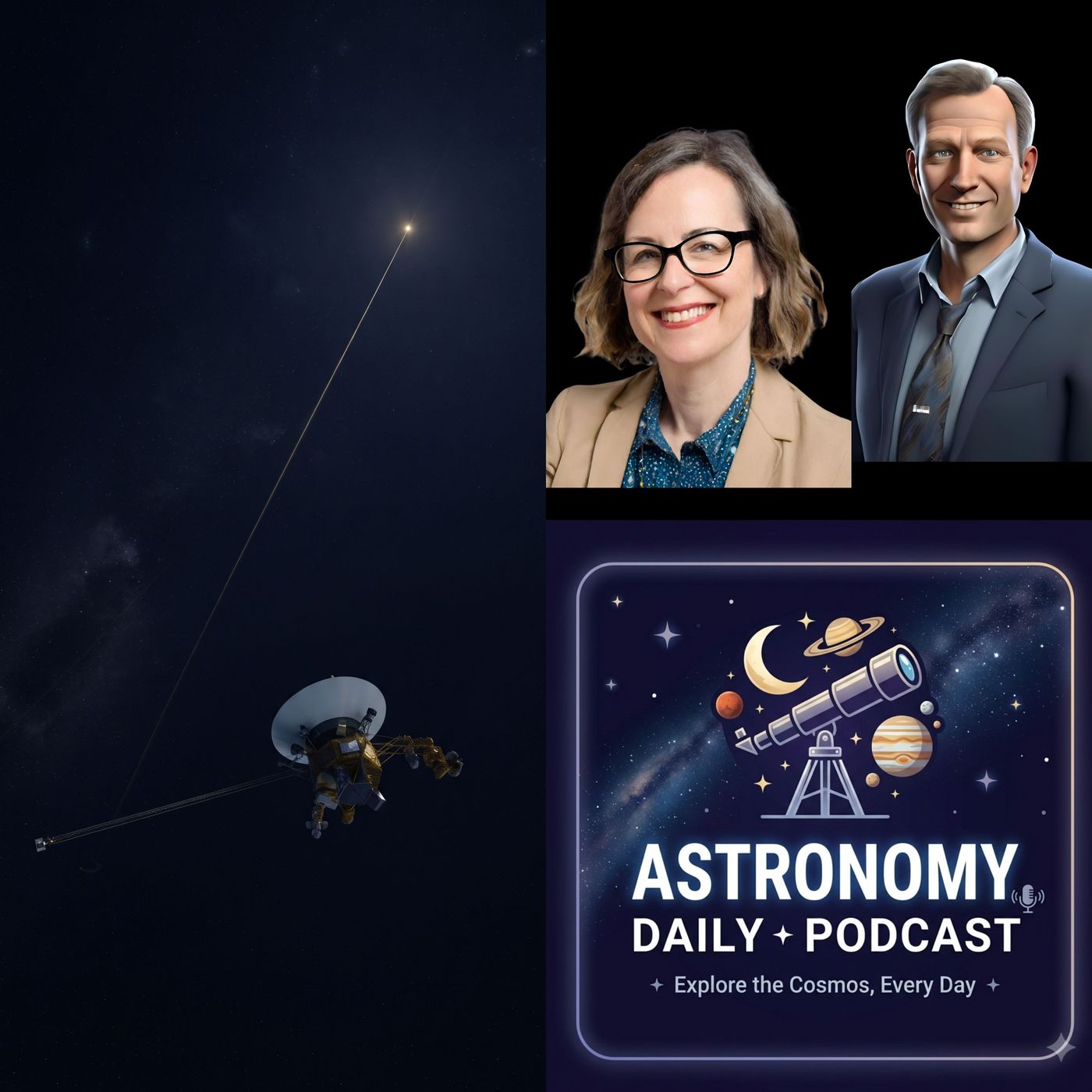
Voyager’s Far-Reaching Milestone, Webb Discovers Frozen Water, Roman Telescope Finishes Alignment...
In this episode
At 9:16 pm Sydney time on Wednesday 18 November 2026, Voyager 1 becomes the first human-made object to reach one light-day from Earth. Anna and Avery explain what that distance means, what it takes to fly a spacecraft when every conversation lasts 48 hours, and why there is no line in space to cross, and they correct a timing error from yesterday's episode. Also: the Webb telescope finds water and carbon dioxide ice around the southern star Beta Pictoris that may be older than the star itself; twelve grains of stratospheric dust point to a reservoir of heavy-oxygen water in the Kuiper Belt; the Roman Space Telescope finishes aligning its instruments; and quick hits on Starship V4, Shenzhou 24, BepiColombo and Hera. Skywatch shows where Voyager is in the sky, with a second chance at the Leonids. In this episode · Voyager 1 reaches one light-day · Beta Pictoris: ice older than its star · Kuiper Belt dust and heavy-oxygen water · Roman Space Telescope aligned · Quick hits: Starship V4, Shenzhou 24, BepiColombo, Hera · Skywatch: where Voyager is, Leonids, dawn planets Sources Story Source Voyager 1 NASA Science, 'Voyager 1: What Is a Light-Day' (5:16:07 a.m. EST, 18 Nov 2026); NASA/JPL advisory M26-086, 'NASA Invites Media, Public to Join Voyager 1 One-Light Day Activities', 10 Nov, updated 13 Nov; Universe Today, 6 Nov 2026 (status and 'Big Bang' fix); Scientific American, 16 Nov 2026 Beta Pictoris ices Betti, Chen et al., 'Carbon dioxide and amorphous water ices in the debris disk around β Pictoris', Science 394, 742–745, 12 Nov 2026, DOI 10.1126/science.adw7770 Kuiper Belt dust Keller, Snead, Liu & McKeegan, 'A primordial heavy water reservoir in the outer solar system', Science Advances 12(46), eaeg1602, 11 Nov 2026, DOI 10.1126/sciadv.aeg1602 Roman NASA Roman blog, 'Instruments on NASA's Roman Space Telescope Get in Sync for Science', 13 Nov 2026 Starship V4 Elon Musk post, 15 Nov 2026, as reported by Space.com, 16 Nov 2026 Shenzhou 24 China Manned Space Agency statement, 7 Nov 2026, as reported by Space.com BepiColombo ESA, 'Latest updates: BepiColombo's arrival at Mercury' (orbit insertion from 21 Nov 2026; 16 burns to March 2027) Skywatch Computed in-session with PyEphem for Sydney, Los Angeles, New York and London; full Moon and supermoon series per NASA 'What's Up', November 2026Become a supporter of this podcast: https://www.spreaker.com/podcast/astronomy-daily-latest-space-news--5648921/support.
Sponsor Details:
Ensure your online privacy by using NordVPN. To get our special listener deal and save a lot of money, visit www.astronomydaily.io/nordvpn. You'll be glad you did!
Get the best secure and private email on the planet. Stop your Government, google and who knows who else spying on every email you write. Do what we did and use ProtonMail. They beleive in privacy and there are no ads in their business model...yet they still provide a free forever service. Check them out and get out special deal at www.astronomydaily.io/protonmail
Become a supporter of Astronomy Daily by joining our Supporters Club. Commercial free episodes daily are only a click way... Click Here
This episode includes AI-generated content.
Anna: Hello, everyone, and welcome to today's episode. Tomorrow night at 16 minutes past 9 in Sydney, a spacecraft launched in 1977 will be so far away that a beam of light leaving Earth would need a full day to catch it. Voyager 1 is about to become the first thing humans have ever built to reach one light day from home. Avery: Also today, 2 stars stories about very old ice. The Webb Telescope has found frozen water and frozen carbon dioxide around the southern star Beta Pictoris. And it looks older than the star.
And 12 specks of dust caught high in our own atmosphere point to a hidden store of unusual water out beyond Neptune. Anna: Plus, the Roman Space Telescope lines itself up a bigger starship on the drawing board. And where in the sky to look for Voyager? I'm Anna. Avery: And I'm Avery. This is Astronomy daily for Tuesday 17th November 2026. Anna: Refer this story a, uh, correction to our own reporting in yesterday's episode. We told you Voyager 1 would reach one light day at 0616 Universal Time. And we called that a quarter past five in the afternoon in Sydney.
That was wrong by four hours. Avery: NASA's own mission page gives the moment as 516 and 7 seconds in the morning. United States Eastern time tomorrow, Wednesday the 18th. That is 10:16 universal time. So the right local times are 9:16 on Wednesday night in Sydney, 5:16 on Wednesday morning in New York, 2:16 in Los Angeles and 10:16 in London. We took yesterday's figure from a secondary report and we should have gone to the source. Apologies. Anna: So the milestone. A light day is a distance, not a time.
It is how far light travels in 24 hours. And NASA puts it at a little over 25.9 billion kilometers, or about 16 billion miles. Astronomers would call it 173 times the distance between the Earth and the Sun. Avery: The best way to feel that number is to climb a ladder. The Moon is about one and a third light seconds away. The sun is eight and a third light minutes. Jupiter, which you can see before dawn this week, is about 44 light minutes away this morning, Neptune is roughly four light hours. Anna: And Voyager 1, after 49 years and two months, nearly 18,000 days of flying has covered what light covers in one day.
It is traveling at about 17km a second, which is fast enough to cross Australia in four minutes. And light still outruns it by a factor of nearly 18,000. Avery: Then take the next rung. The nearest star, Proxima Centauri, is a little over four light years away. Voyager has completed one day of a journey that light itself takes four years to make. That is the scale of the gap between the planets and the stars. Anna: For the people who fly the spacecraft, this is a working problem. A command sent from Earth now takes a full day to arrive, and the reply takes another day to come back.
If you ask Voyager a question on Monday morning, you find out on Wednesday morning whether it heard you. Avery: And it very nearly stopped answering. As we reported at the end of October, Voyager 1 went silent for about 48 hours. Last month, Universe Today reports that engineers got it back with a procedure the team nicknamed the Big Bang, swapping three power hungry units, two heaters and the old tape recorder among them for three low power alternatives, all at the same moment, because those units are also what, uh, keep the spacecraft warm.
Anna: Power is the whole story. Now, the plutonium generator loses about 4 watts every year, and the spacecraft runs on a little over 200. Of the 10 instruments Voyager launched with two are reported still to be switched the magnetometer and the plasma wave instrument that listens to the thin gas between the stars. Avery: We ran some numbers of our own on this because one thing puzzled us. Some NASA pages say one light day from Earth, and at least one says from the Sun. Those are different moments.
Anna: Right now, the Earth is on the far side of the sun from Voyager, so we are about three quarters of an Earth sun distance farther from it than the sun is. By our rough calculation, Voyager will not be one light day from the sun until early February. Today's milestone is the Earth one, and NASA's detailed pages are clear about that. Avery: There is a second wrinkle. The Earth goes round the sun at about 30 km a second, nearly twice Voyager speed. So for part of every year, we are chasing Voyager faster than it is leaving, and the gap actually shrinks.
Our model has that happening from late January to about April. Anna: So could it slip back inside one light day? We checked, and on our numbers, no. The shrinkage is smaller than the head start. But treat that as R arithmetic built on rounded figures and not as NASA's. Avery: One more caution. There is no line in space here. Voyager crossed the real boundary, the edge of the Sun's bubble of charged particles, back in August 2012. As one of the mission's magnetometer scientists told Scientific American, nothing is special about this spot except that it is extremely far away.
It is a milestone for us, not for the spacecraft. Anna: The Australian connection is real and we should describe it accurately. Voyager talks to Earth through NASA's Deep Space Network. Three stations spaced around the globe. In California, in Spain, and at Tidbinbilla outside Canberra, which CSIRO runs for NASA. Voyager 1 sits north of the celestial equator, so all three can reach it. It is the sister ship Voyager 2 far to the south that only Canberra can command. Avery: NASA and JPL hold a public discussion with the mission team on Thursday at, uh, midday Eastern time, and we will bring you anything new from it.
The 50th anniversary of launch falls next September. Voyager 2 does not reach its own light day until November 2035. Anna: And Voyager 1 keeps going. In about 40,000 years, it will drift within two light years of a small star called Gliese 445. One day down Avery: 63 light years away, in the southern constellation of Pictor, the Painter's Easel is a star you can see without a telescope. Beta Pictoris is young, around 20 million years old. And since 1984, when it was photographed from Las Campanas in Chile, we have known it is wrapped in a disk of dust and rubble where planets are still taking shape.
Anna: Astronomers have long assumed that disk must contain ice. Nobody had seen it directly. Now a team led by Sarah Betty of the Space Telescope Science Institute, writing in the journal Science last Thursday has. Avery: They used the Webb Telescope's Near Infrared Spectrograph to map starlight reflected off the disk on both sides of the star. Ice leaves fingerprints in that reflected light. Frozen water takes a broad bite out of the spectrum near three microns. Frozen carbon dioxide takes a sharper one a little past four.
Both are there. Anna: The detail that matters is the kind of water ice in the ice in your freezer. The molecules sit in a neat repeating lattice that is crystalline ice. If water freezes somewhere extremely cold, molecule by molecule, it sets as a jumble instead of called amorphous ice. Warm it up once and it snaps into crystals and it never goes. Back. Avery: Around Beta Pictoris, less than 7% of the ice is crystalline. Almost all of it is the jumbled kind, with their carbon dioxide mixed through it.
Anna: The reading reported from the paper is that this ice has never been warm. It most likely formed in the dark cloud the star was born from, which would make the ice older than the star. It also cannot last long in the open, so collisions between comet like bodies must keep grinding out fresh supplies. Avery: There is a, uh, neat contrast next door. Sibling star HD 18131327, born in the same group at the same time, was found last year to have crystalline ice in its disc. Two siblings, two different kinds of ice.
Anna: Two cautions from us. We have read the abstract and the coverage, not the full paper and jumbled Ice is not a birth certificate on its own, because radiation can scramble crystalline ice back into disorder, the word to hold onto is likely. Avery: Regular listeners will remember Beta Pictoris from October and the cat's tail of dust from a giant collision. This is the same disk. And now we know that rubble is icy, and it's one for the south. From Sydney, it climbs high after midnight, not far from Canopus.
From London, it never rises Anna: from, um, an icy belt around another star to the one around our own. This story starts about 20 kilometers above the ground, where NASA aircraft flies sticky collectors through the stratosphere and bring home dust that has drifted in from space. Avery: Each grain is smaller than the width of a hair. A team led by Lindsey Keller at NASA's Johnson Space center with colleagues at AH UCLA has studied 12 of them. And, um, the paper came out last Wednesday in Science Advances Anna: by its scars.
While a dust grain drifts through space, particles blasted out of the sun punch microscopic tracks through its minerals. The longer the trip, the more tracks. These 12 are riddled with them, far too many for dust from the asteroid belt or a passing comet. The team's argument is that they spend a very long time spiraling inward from the Kuiper Belt, the ring of icy bodies beyond Neptune. Avery: And the grains are mostly made of minerals that only form when rock sits in water. So inside whatever distant body they came from, ice once melted.
Anna: Then the isotopes, oxygen comes in three stable weights 16, 17 and 18. And nearly all of it is 16. The water that altered these grains was unusually rich in the two heavy ones. Coverage of the paper puts it, uh, at up to about 15% more oxygen 18 than Earth's oceans. And that is an upper estimate. Avery: A, uh, quick clarification. When people say heavy water, they usually mean heavy hydrogen. This is heavy oxygen. Anna: Theorists predicted this decades ago in the cloud that made the solar system.
Ultraviolet light should have sorted oxygen so that the heavy kinds ended up locked in ice far from the sun. The trouble was finding any. Until now, the best evidence was a few microscopic crystals in a single meteorite from the Algerian desert. Avery: The limits are plain enough. 12 grains. And the isotope measurements come from a subset of them. Nobody m watched these leave the Kuiper Belt. The origin is read from the damage, and the reservoir is inferred, not sampled. One more note for the record.
A version of this manuscript has been on NASA's technical server since last year. What is new is that it has passed pure review. Anna: Put the two stories side by side around Beta Pictoris. Webb sees untouched ice in A young belt of comets. Here in dust from our own old one, is the chemical memory of ice. Like it Avery: an update on a spacecraft we have followed since before it launched. NASA's Nancy Grace Roman Space Telescope has finished aligning its instruments. The mission team announced it last Friday.
Anna: That sounds like housekeeping. So here's why it isn't. Everything on Roman was lined up on the ground. Then it rode a Falcon heavy to space at the end of August, went from room temperature to deep cold and from gravity to none. Things move. Not much, but Roman's whole purpose is precision. Avery: So for weeks the team has pointed it at, uh, test fields and measured exactly where each part now sits, redrawing what they call the telescope's internal map. Project astronomer at the Space Telescope Science Institute, Tony Sohn says the result is aligned to within a tiny fraction of a hair's breadth of perfection.
Anna: The main camera has 18 detectors and they double as the telescope's steering. While Roman observes, they lock onto guide stars and hold the telescope still. All 18 have to agree on where those stars are. NASA's program scientist Dominic Venford says Roman must be at least 10 times steadier than Hubble or Webb. Avery: The second instrument, the coronagraph, is the experimental one built to blot out a star so that planets beside it show up. Its team has now tuned the mirrors that feed it. Next, they exercise more than 3,000 tiny moving parts in its deformable mirrors.
Mirrors that change shape to cancel stray starlight. Doing that live in space on real stars has never been done. Anna: And a bonus. Whenever the coronagraph stares at one star for hours, the main camera will be staring just as long at a patch of sky next door. Free deep fields and places nobody chose. Avery: Where things stand. Roman is in the last phase of commissioning and closing on its station a million and a half kilometers from Earth. The first sharp science images are expected early in the new year.
And remember why we care. This is a telescope built to test whether dark energy is changing, a question Australian led supernova work reopened in September. Anna: Quick hits Starship first as we record. SpaceX has not published a cause for the loss of booster 22 on Friday's flight and its position is still that the root cause is under investigation. So nothing to add to yesterday's account. Avery: What is new is a look ahead. Elon Musk posted on Sunday that uh, the next version of the ship V4 will be about 70 meters long, roughly 40% longer than today's, carry over 60% more propellant and fly with nine engines, three more than now.
That is a design statement, not a schedule. Anna: Second, China. The Shenzhou 24 crew is expected to launch to the Tiangong Space Station before the end of this month, and one seat goes to an astronaut from Pakistan for a stay of about a week. That would be the first visitor from another country in the station's history. China has not announced a launch date and by custom names the crew only a day ahead. Avery: Third, BepiColombo. This Saturday, the European and Japanese mission begins breaking into orbit around Mercury, the first of 16 engine burns that run through to March.
We'll have the full story on Friday Anna: and one week Today, on the 25th, the European Space Agency shows us what Hera has seen of Dimorphos, the asteroid moon NASA struck in 2022. Avery: Skywatch with our own numbers for Sydney, Los Angeles, New York and London. And we start with something you cannot see. Anna: Voyager 1 is far too faint for any telescope, but you can know where it is. It lies in the constellation Ophiuchus, the serpent bearer, about 5 degrees from the star Ras Al Haga, which marks the Serpent Bearer's head.
Five degrees is about three fingers held at arm's length. Avery: This one favors the north as, uh, the sky darkens tonight. The that spot is around 30 degrees up in the west. From Los Angeles, New York and London, find Rasal Hague. Look a little to its lower right and, um, you're looking down Voyager's road Anna: from Sydney. It is already set by the time the sky is dark for us. Voyager is a daytime object this month up there behind the blue. So at 9:16 tonight when it crosses the line, it will be below our western horizon.
We'll have to take it on trust. Avery: The Leonid meteor shower is at its peak as this episode goes out in the Americas and Europe. The hours before dawn on Wednesday the 18th are the best of the year, with 10 to 15 meteors an hour under a dark sky in Australia, Thursday morning is the second chance. Expect only two or three an hour here because the radiance is just 17 degrees up. As dawn begins, the moon is down by about one in the north and soon after two in Sydney, so the hours before dawn are dark Anna: while you're out.
Jupiter and Mars are still side by side near the Leonid radiant, now a degree and three quarters apart and widening. Jupiter's the bright one, and remember that ladder its light left 44 minutes ago. Mars is the fainter orange one, 11 light minutes away. Avery: Lower down, Venus is a brilliant morning star, 17 to 19 degrees up from the American cities, about an hour before sunrise, but only about seven from Sydney. Northern listeners also get Mercury at its bestest weekend low in the east southeast from Sydney.
It stays in the glare, Anna: the safety line. As always, put binoculars and telescopes away well before sunrise and never look at the sun without a filter Certified to the ISO 123122 standard Avery: and mark next Tuesday. The Moon is full on the 24th at uh, 14:53 universal time, which is just before 2 on Wednesday morning in Sydney. And um, and it is the first of three supermoons in a row. It will look full on both nights in both hemispheres. Anna: That's the episode Voyager 1, A Full Light day from home ice that may be older than its star.
A uh hitting reservoir red from 12 grains of dust and a new telescope lined up to within a hair. Avery: On Thursday, we'll have whatever the Voyager team says at JPL and on Friday, bepicolombo at the gates of Mercury. Show notes, sources and the full back catalog [email protected] Anna: if you flashed a light at Voyager last night or caught a Leonid, tell us through the contact form on the site. We read every one. You'll also find us as astrodaily Pod on, um, the usual platforms. Avery: Astronomy Daily is part of the bytes.com podcast network.
Hi, I'm Avery. Anna: And I'm Anna. Clear skies and we'll see you tomorrow.
 Apple Podcasts
 Spotify
 Pocket Casts
 Castbox
 Overcast
 Podbean
 iHeartRadio
 Castro
 Goodpods
 Moon FM
 Podcast Addict
 Podcast Republic
 YouTube