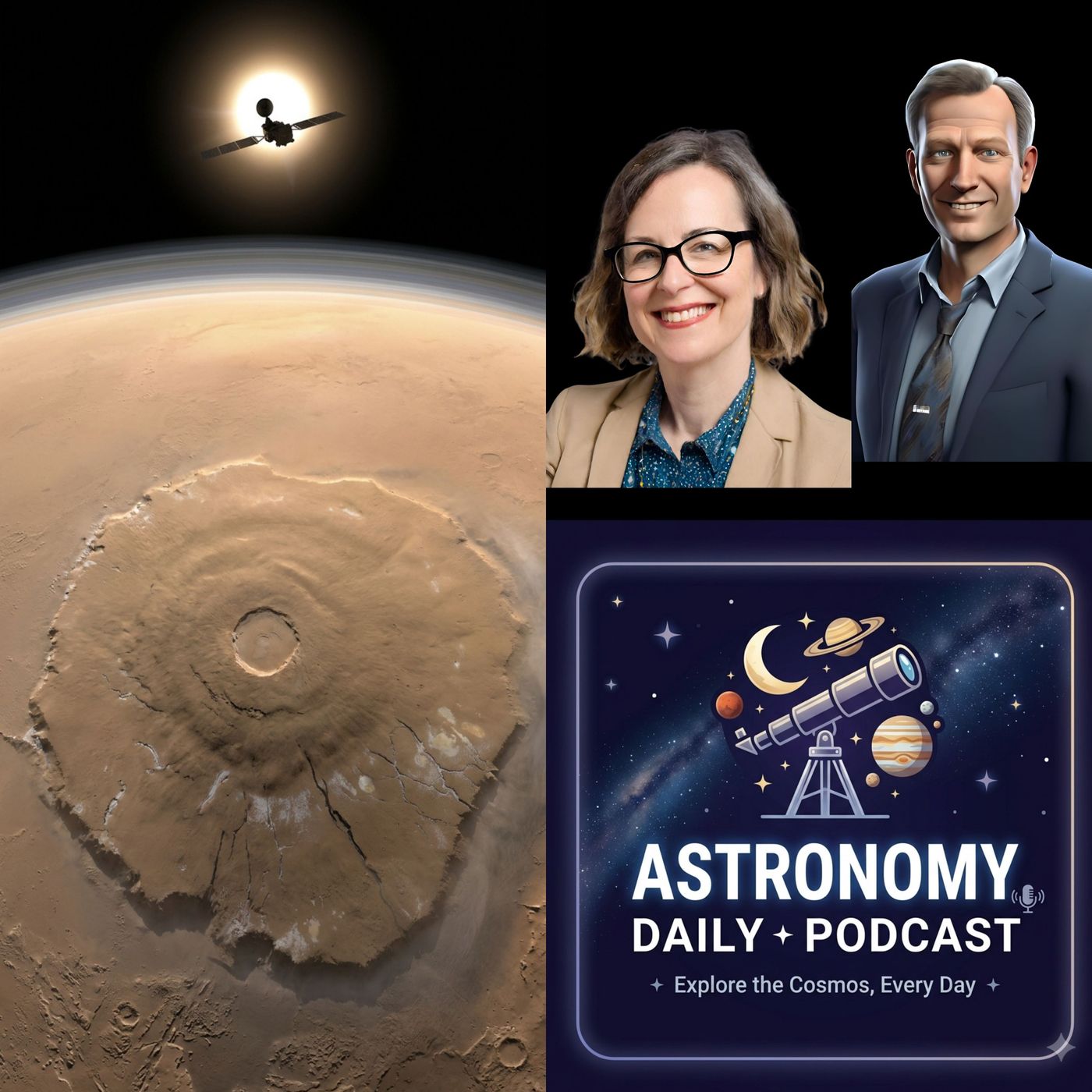
Mars May Still Be Breathing: Alba Mons’ Mysterious Gas and Swift’s Final Plunge
In this episode
Is Mars still volcanically alive? Europe's ExoMars Trace Gas Orbiter keeps catching hydrogen chloride, a gas that comes out of volcanoes on Earth, above fresh cracks on the giant Alba Mons volcano, in the wrong season, in one place and low to the ground. We unpack the evidence, the proposed 'ice lid', and everything this result is not. Then it's The Week That Was: two black holes in one early galaxy, Swift's fiery end over Sumatra, ESCAPADE's powered slingshots over Australia, a planet rescued from Webb's glare, and the cosmic leaf blower. Plus the week's sky from both hemispheres. In this episode • Lead: Hydrogen chloride detections at Alba Mons as a potential sign of igneous activity on Mars (Trokhimovskiy, Mège et al., Science Advances, 4 Nov 2026). Detections first presented at 2025 conferences. • Week That Was: LID-1166 dual black holes (E220); Swift re-entry, 4 Nov (E221); ESCAPADE powered flybys (E222); FLIP digital-twin coronagraph and 51 Eridani b (E223); Lyman-alpha 'leaf blower' (E224). • Arc updates: AR4566 M3.5 flare and storm watch; Starship Flight 15; Voyager 1 one light-day; BepiColombo; Hera. • Skywatch: Venus and Spica; thin crescent Moon; new Moon 9 Nov; spotting ESCAPADE Gold; Mars–Jupiter 16 Nov; aurora watch; ISO 12312-2 eye safety. Sources • Science Advances, DOI 10.1126/sciadv.aeb9422 — 'Enigmatic HCl detections as a potential signature of igneous activity on Mars' • ESA release, 4 Nov 2026 — European orbiter detects hints of volcanic activity on Mars • NASA ESCAPADE blog, 2 Nov 2026 — science.nasa.gov/blogs/escapade • NASA Swift blog — science.nasa.gov/blogs/swift • EarthSky Sun news, 6 Nov 2026 astronomydaily.io · @AstroDailyPod · Bitesz.com Podcast Network YouTube description Is Mars still volcanically alive? ESA's ExoMars Trace Gas Orbiter has caught hydrogen chloride above fresh fissures on Alba Mons, out of season, in one place, low to the ground. We look at the evidence, the proposed ice lid, and what this result is NOT. Then The Week That Was: dual black holes in LID-1166, Swift's re-entry, ESCAPADE's slingshot over Australia, FLIP and 51 Eridani b, and the cosmic leaf blower. Plus this week's sky for both hemispheres. astronomydaily.io · @AstroDailyPod · Bitesz.com Podcast Network Chapters (estimate — confirm against final audio) 00:00 Cold open 00:40 Is Mars still breathing? Hydrogen chloride at Alba Mons 09:05 The Week That Was 14:10 Skywatch: Venus, Spica, ESCAPADE, Mars and Jupiter 17:30 OutroBecome a supporter of this podcast: https://www.spreaker.com/podcast/astronomy-daily-latest-space-news--5648921/support.
Sponsor Details:
Ensure your online privacy by using NordVPN. To get our special listener deal and save a lot of money, visit www.astronomydaily.io/nordvpn. You'll be glad you did!
Get the best secure and private email on the planet. Stop your Government, google and who knows who else spying on every email you write. Do what we did and use ProtonMail. They beleive in privacy and there are no ads in their business model...yet they still provide a free forever service. Check them out and get out special deal at www.astronomydaily.io/protonmail
Become a supporter of Astronomy Daily by joining our Supporters Club. Commercial free episodes daily are only a click way... Click Here
This episode includes AI-generated content.
Anna: Hello, everyone. On the northern flanks of Alba Mons, the biggest volcano on Mars by area, there are cracks in the ground less than a metre wide. And above those cracks, at exactly the wrong time of year, a, uh, European orbiter keeps catching a trace of a gas that here on Earth comes out of volcanoes. So is Mars still breathing? That's our lead today. Then it's the week that was. Two black holes in one galaxy, Swift's final plunge escapade. Slingshotting over Australia, a planet pulled out of the glare Avery: and a, uh, cosmic leaf blower Anna: and the weak sky from both hemispheres.
This is the weekend Wrap. I'm Anna. Avery: And I'm Avery, coming to you from Sydney. Let's get into it. Anna: Let's start with a question. Planetary scientists have argued about it for decades. Mars has the biggest volcanoes in the solar system. Olympus Mons is roughly two and a half times the height of Everest. But is any of that volcanic system still alive today? Or is Mars a planet whose fires went out long ago? Avery: And the honest answer until now has been that nobody has ever caught Mars in the act.
Anna: Right. The list of bodies in the solar system we know are volcanically active right now is short. Earth, Venus and Jupiter's moon IO Mars has had tantalising hints. NASA's InSight lander recorded more than 1300 seismic events. So the planet still quakes. And crater counting on some lava surfaces is given geologically very young ages. But young in geology can still mean millions of years. What nobody has had is something you could point to and say that is happening now. Avery: So what's changed this week?
Anna: A paper published in Science advances on the 4th of November. The co leads are Alexander Trukomovsky of the Space Research Institute in Moscow and Daniel Medji of the Space Research Centre of the Polish Academy of Sciences, who's also at the University of Bern. Their title is Careful and I want to read it as written. Enigmatic HCL detections as a potential signature of igneous activity on Mars. Enigmatic potential signature. Hold on to those words. Avery: HCL being hydrogen chloride. Anna: Hydrogen chloride, yes.
A pungent corrosive gas. Meija said he'd discourage anyone from sniffing it on Earth. It's one of the gases that comes out of volcanoes, released from chlorine compounds dissolved in magma as the magma rises and the pressure drops. And this was seen by which spacecraft? The ExoMars Trace Gas Orbiter, the joint ESA and Rose Cosmos mission that's been at Mars since 2016. The instrument is the Atmospheric Chemistry Suite. It works by solar occultation as the orbiter watches the sun rise or set through the edge of the Martian atmosphere.
Sunlight passes through a long slice of air on its way to the spectrometer. And every gas in that slice takes its own bite out of the spectrum. It's extremely sensitive and it gives you altitude for free because as the sun sinks you can, you're looking through lower and lower layers. So it isn't looking down at the ground, it's looking sideways through the air. Exactly. Which matters for what comes next. Avery: Now I seem to remember hydrogen chloride on Mars isn't actually new. Anna: It isn't, and this is the key to the whole story.
The same orbiter, uh, discovered hydrogen chloride on Mars in 2021. It was the first new gas the mission had found. And at the time everyone asked the obvious is this volcanic? The answer then was no. The gas turned up in widely separated places at the same time. It came with the dusty warm season around perihelion, when Mars is closest to the sun. And it uh, came without the other gases you'd expect from a volcano. So the leading explanation became salty dust, which is winds loft dust carrying chloride salts.
Water vapour rises in the warm season and chemistry in the air releases hydrogen chloride. Then as the planet cools, the gas sticks to water ice crystals and disappears from view. So hydrogen chloride on Mars is normally a warm season, global dust driven thing. That's the baseline which makes the new detection stand out. Avery: Got it. Anna: Over two Martian years, the team examined 78 occultations in this part of the planet. During the cold season around Aphelion, when Mars is farthest from M, the sun and hydrogen chloride should be absent.
Eight of them showed clear hydrogen chloride. All eight clustered in a narrow band of longitude around Alba Mons. And all of them sat low within the bottom 10 kilometres of the atmosphere. Avery: Wrong season, one place close to the ground. Anna: That's the argument in six words. If the gas were coming from global dust chemistry, it should be spread out and it should be high mixed through the atmosphere. Instead it's local and low, the pattern you'd expect if something on the surface were leaking it.
And because hydrogen chloride is pulled out of the air quickly by ice in that season, it can't travel far. A short lifetime is why a source would show up as a local signal at all. Avery: They know where on the surface Anna: they went looking. Using high resolution images from the orbiter's own CASIS camera and from NASA's HiRISE on the Mars Reconnaissance Orbiter, they mapped swarms of fresh narrow fissures on the volcano's northern flanks. Under a metre wide, some only tens of centimetres across and several hundred metres long.
One casus image shows white spots that the team suggests may be deposits around vents where gas escapes. Though that is an interpretation, the authors propose these cracks as pathways rooted in magma bodies at depth. Avery: But hang on. If magma is leaking gas, why only in one season? Anna: Their proposed answer is ice. The idea is that the gas doesn't come straight out of a magma chamber into the sky. It moves up into a frozen buffer layer, hermafrost above the magma. In the cold season, the fissures are effectively sealed by ice and the gas is trapped.
As the ground warms into early northern summer, the ice sublimates and the trapped gas is released into the lowest layer of the atmosphere, right where the orbiter catches it. Avery: A lid that opens once a year. Anna: That's the picture. And it's worth saying plainly that mechanism is an interpretation that fits the data. It is not something anyone has watched happen. Avery: What do the authors actually conclude? Anna: In the paper's words, their results are, uh, best explained by ongoing igneous processes in the Martian interior.
MEJ put it more simply in ESA's release. Mars has retained enough internal heat to support volcanic activity until recently, and possibly still does. Mars, in this reading, isn't geologically dead. It's dormant. Avery: Okay, time for our usual list of what this is not. Anna: And it matters here, because the headlines have been loud. First, nobody has seen an eruption. There's no fresh lava and no measured heat anomaly at Alba Mons. Second, sulphur dioxide, the gas that would most strongly point to active eruptions, still has not been detected on Mars.
The team argue that on Mars, with its chemistry, hydrogen chloride may be the more telling gas for a quiet magma chamber, but the absence of sulphur dioxide is still part of the honest picture. Third, the amounts are tiny parts per billion. Fourth, these are eight detections out of 78. And fifth, the habitability angle, Avery: because the word life has been in a lot of the coverage Anna: it has. MEJ has said that if hydrothermal systems are active there, looking for life in those fissures would make a lot of sense.
Since heat, water and rock together are what microbes use on Earth. That's a reasonable statement about where to look. It is not a finding. This paper detects a gas. It does not detect water or a habitable environment or anything alive. Avery: And one disclosure from us. Anna: Yes, the paper was published this week, but the Alba Mann's detections themselves aren't brand new. The team first presented them at planetary science conferences in 2025. What's new this week is the full peer reviewed case with the chemistry worked through.
Avery: So if it holds up, why does it matter? Anna: Three reasons. 1 Small planets are supposed to lose their internal heat fast. So a uh, Mars that still has magma near the surface tells us something about how it's built and that how it cools. 2 It ties together threads we've been following. Back in episode 211 we covered a Marsquake that ruptured along Valles Marineris and Insights quakes clustered at Cerberus Fossae, another young volcanic region. A planet with magma at depth is a planet that still shakes.
And three it gives Mars exploration a target if you want to look for warm ground and possibly water. This narrows down where Avery: end the test. Anna: The obvious one is repetition. If the source is real, Alba Mons should light up again next early northern summer in the same place low down. The team also want to know whether similar signals appear over other young volcanic provinces. Tharsis more widely and Cerberus Fossae. And the big prize would be a detection of sulphur dioxide or of a heat signature at the same spot.
Any one of those would turn a potential signature into something much harder to argue with. Avery: So for now, enigmatic potential signature Anna: exactly where we started. Mars may be breathing. We've caught what might be one breath a few times in one place. Now we wait to see if it breathes again. Avery: Time for the week. That was our run through this week's stories in the order they happened, with any updates since. Anna: Monday's lead was LID 1166, a galaxy seen when the universe was only about 1/10 of its current age at a redshift of around 4 1/2.
Using Webb's Near Spec Integral Field Unit, together with Alma, a team led by Haiwan Su at NOIR lab found two actively feeding supermassive black holes inside it, only about 1 1/2 kiloparsecs apart, roughly 5,000 light years. That's a merger caught in progress very early on. It was published in nature astronomy on 30 October. After circulating as a preprint since July, which we disclosed at the time, Avery: Tuesday's lead was swift and that story now has its ending. After nearly 22 years exploring gamma ray bursts and the most violent explosions in the universe, NASA's Swift observatory re entered the atmosphere on Wednesday 4th November.
US Space Force put the re entry at 12:39 Universal Time over North Sumatra in Indonesia. That was 11:39pm Wednesday here in Sydney. Anna: Swift was designed for a two year mission, and for this show it closes a thread that started with you, our listeners back in episode 187. Your questions through the contact form asked what the link mission was doing as it tried to boost Swift's orbit. That rescue didn't come in time, but you followed it all the way down. Thank you. Wednesday's lead was NASA's twin escapade spacecraft Blue and Gold.
They launched on New Avery: Glenn in November 2025 when Earth and Mars were on opposite sides of the sun. Instead of waiting on the ground, they spent a year looping out around the Sun Earth L2 point and they've now come home for a powered flyby, swinging past Earth and firing their engines at uh Anna: closest approach. Each burn is about nine minutes and adds more than a thousand miles an hour, taking each Spacecra about 6.3 to about 6.7 miles per second. NASA says no Mars bound spacecraft has ever successfully flown a powered flyby like this, and both burns happen over southern Australia.
Lose was scheduled to begin at 8.51pm Australian Eastern Daylight Time on Saturday 7 November. Gold follows at 9.51pm on Monday, the night Avery: at the time we recorded, NASA hadn't yet posted confirmation of Blue's Burn. So watch NASA's Escapade blog even once the burn is confirmed, the team says it will take several days to know exactly how well the spacecraft is aimed for Mars, with small corrections planned along the way. Anna: If all goes well. The pair arrive at Mars on the 7th and 9th of September 2027 to become the first spacecraft to fly in formation around another planet, studying how the solar wind strips away the Martian atmosphere.
Avery: Thursday's lead was a clever piece of image processing. Published in nature on the 4th of November, Webb's coronagraph blocks a star's light so faint planets can be seen beside it. But leftover glare still swamps the faintest signals. The usual fix is to subtract a picture of a different reference star taken at a different time. Anna: The team, Ferrer, Chavez and Wang at Northwestern with Kathryn Bauman at Caltech, Bill Freeman at MIT and Laurent Pueo at the Space Telescope Science Institute built something they call flip, a physics based digital twin of the coronagraph itself tuned to match each frame.
They report sensitivity improvements of 2 to 15 times across three test stars, and it recovered the young planet 51 Eridani b at a wavelength where it had previously vanished into the glare, right where the interesting atmospheric chemistry is. It isn't a new planet, it's a better way of seeing ones we already know about and maybe some we don't yet, Avery: and Friday's lead was about the surprisingly bright galaxies Webb keeps finding in the early universe. Giam Menon at the Flatiron Institute, who did his PhD at the Australian National University, and colleagues published in the astrophysical journal on 4 November suggest that the pressure of Lyman Alpha light ultraviolet light from hydrogen can push diffuse gas out of the young star clusters that make it clear the gas and the dust and more starlight escapes.
Anna: Our three caveats from Friday still stand. It's one contributor, not the whole answer. The study works with snapshots of existing simulations rather than a full time evolving model, and the preprint first appeared in May. Avery: A few quick Arctic Updates the Sun has woken up a little sunspot region. AR 4566 fired an M UM3.5 flare that peaked at 18:33 Universal Time on 5 November, and NOAA forecasters flagged minor to moderate G1 to G2. Geomagnetic storm levels is possible on the 7th. More on Aurora in the Skywatch Anna: Starship Flight 15 is targeted for mid November, with the 13th the date being talked about, but SpaceX hasn't posted it.
As always, targeted not scheduled Avery: Voyager 1 is due to reach one light day from Earth around 18 November. That means a signal sent at breakfast arrives at breakfast the next day, Anna: and BepiColombo's gravity capture at Mercury is on 21st November. HERA continues its approach to Didymos and Dywarfos with its detailed look at the dark crater. Still to come later this month Avery: and to wrap things for this episode Anna: now to the sky this week from both hemispheres. We've calculated the numbers ourselves for Sydney, Los Angeles, New York and London.
Avery: Kicking off with Venus and Spica, um, before dawn. Anna: Venus has moved into the morning sky after passing between us and the sun, and this week it sits right beside Spica, uh, the brightest star in Virgo. They stay about one and a quarter degrees apart all week, a little more than two full moons. Venus is a thin crescent through a telescope only about 6% lit, but its disc is big. Northern observers get the better view half an hour before sunrise. Venus is 12 to 16 degrees up from London, New York and Los Angeles against 9 or 10 degrees from Sydney.
Look low in the east with a clear horizon, Avery: and Venus reaches a stationary point on 11 November, the day its apparent drift against the stars reverses direction. Not something you'll see in one night. But if you sketch Venus against Spica across the week, you'll catch it Slowing down Anna: and our Moon Avery: on Sunday morning the 8th, a very thin crescent moon, only about 2.5% lit, sits about 4 1/2 degrees from Venus as seen from Sydney, 7 degrees up 30 minutes before sunrise. It's a hard catch.
Binoculars help from the Northern Hemisphere. The Moon is barely clearing the horizon at that time, so this one leans south. New moon follows at UH0702 universal time on Monday the 9th, so the week's evenings are dark. Anna: That darkness helps if you want to try for escapade gold. NASA says it should be visible through a telescope as a faint point moving slowly against the stars. From the western United States, it'll be best between 1 and 2 in the morning Pacific Time on Monday 9th November before it slips below the horizon about an hour before its burn.
And the burn itself at 9:51pm AEDT Monday happens over southern Australia, so observers with telescopes in the south get the closest pass. NASA recommends JPL's Horizon System for exact coordinates from where you are Avery: in the predawn sky. Mars is closing in on Jupiter. By our calculation they're closest at UH2 universal time on 16 November, about 1.2 degrees apart. Some published listings give less than a degree, so expect slightly different numbers depending on where you look. But either way it's a lovely pairing for binoculars.
This one strongly favours the north. An hour before sunrise on the 16th, Jupiter stands 62 degrees up from New York, 68 from Los Angeles and 52 from London against about 3.32degrees from Sydney. Southern observers still get a good view just lower in the northeast. Anna: With that M M class flare and the storm watch, there is a chance of aurora around the 7th and 8th for high latitude observers in both hemispheres. That's the aurora borealis across Canada, the northern U.S. and Scotland, and the Aurora Australis from Tasmania, southern Victoria and New Zealand's South Island.
Check the Bureau of Meteorology, Space Weather Forecasting Centre in Australia or NOAA's Space Weather Prediction Centre in the US before heading out. If things are quiet, enjoy the dark skies anyway. Avery: And our standing reminder never look at the sun directly through binoculars or through a telescope without proper protection. For any solar viewing, use only certified solar filters or eclipse glasses that meet the ISO 123122 international safety standard. And that includes keeping telescopes and binoculars well away from the sun.
When you're hunting Venus close to sunrise, Anna: please take these warnings seriously as your eye health is at stake here. That's the weekend rat Avery: our lead hydrogen chloride leaking from fresh cracks on Alba Mons out of season one place low to the ground and possibly the first sign that Mars still has live magma. Possibly. Anna: Plus Swift's final orbit escapades burns over Australia, a planet rescued from the glare, and a cosmic leaf blower. If you've got a question about any of it, the contact form at astronomydaily IO is the place.
Your questions have shaped the show more than once. Avery: You'll find show notes, the full back catalogue and our newsletter at astronomydaily IO and we're AstroDaily Pod on social media. Anna: We'll be back on Monday. I'm Anna. Clear skies, everyone.
 Apple Podcasts
 Spotify
 Pocket Casts
 Castbox
 Overcast
 Podbean
 iHeartRadio
 Castro
 Goodpods
 Moon FM
 Podcast Addict
 Podcast Republic
 YouTube