A Planet Vanishes from View: Uranus’ Shifting Fields, Meerkat’s Hydrogen Map...
In this episode
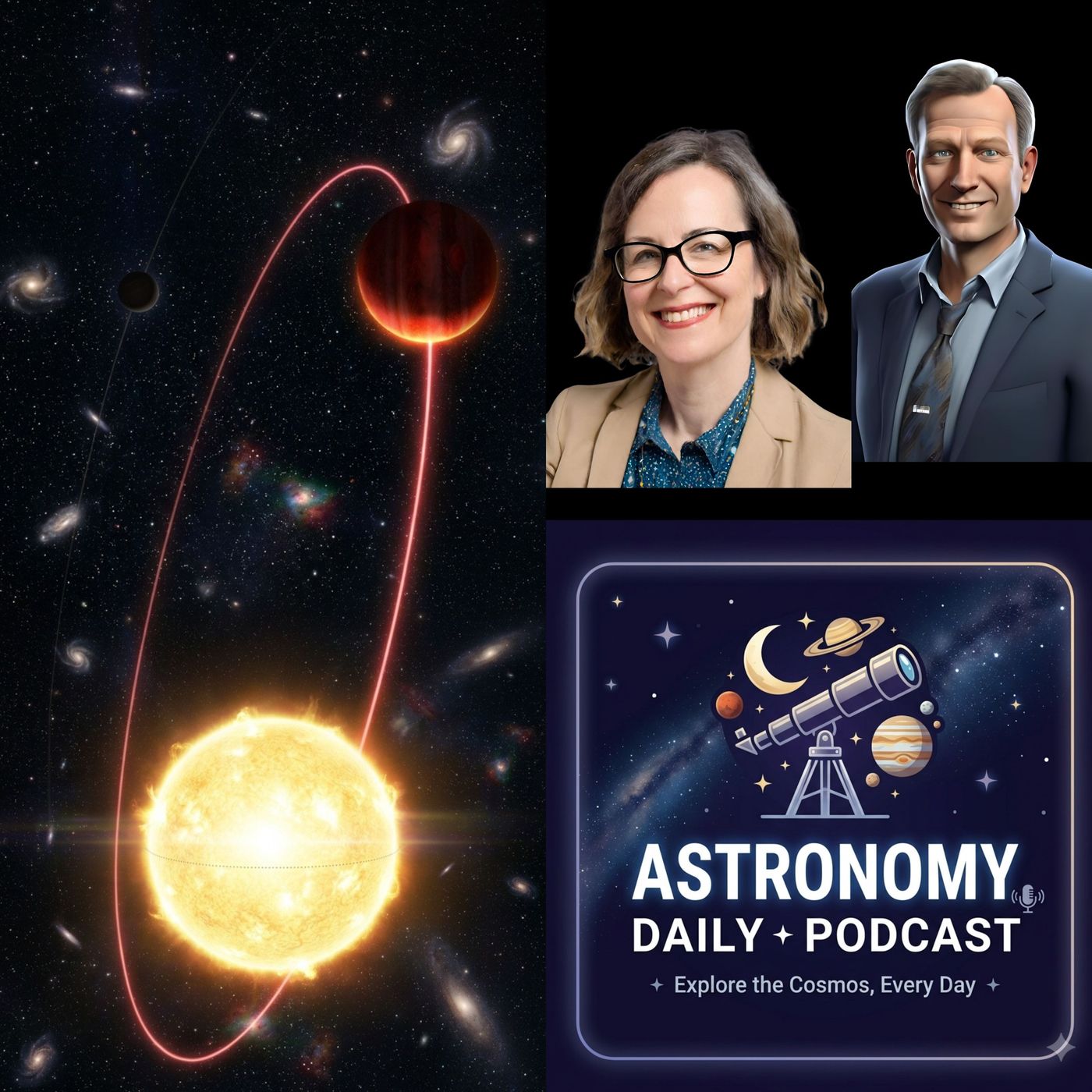
Show notesA hot Jupiter called TOI-2535 b has become the first planet around a single star seen to stop transiting, tipped out of line by an unseen neighbour. Plus: why Uranus and Neptune have scrambled magnetic fields, MeerKAT measuring how cosmic hydrogen clusters, Euclid's first big data release, ESCAPADE heading for Mars, Starship Flight 15's double-catch attempt, the 2026 ozone hole, and a both-hemispheres sky with Mars and Jupiter 1.2 degrees apart. The planet that stopped transiting. TOI-2535 b, an 8.24-day hot Jupiter ~1,000 light-years away, ran up to ~6 hours early or late and its transits shortened and faded over seven years of TESS data until they vanished in 2026. A hidden companion of at least Saturn mass, likely in resonance on a tilted orbit, is making both orbits precess. Transits should return in 30–50 years. Yee, Petigura et al., The Astrophysical Journal Letters, 9 Nov 2026. Ice giants' scrambled magnetic fields. Dynamo models with electrical conductivity rising with depth reproduce Uranus- and Neptune-like fields, and suggest their tilt could shift by tens of degrees within decades. Aurora observations could test for change since Voyager 2. Yan et al., Communications Physics. MeerKLASS hears the cosmic web. Running MeerKAT's 64 dishes as independent telescopes, the MeerKLASS collaboration detected the 21-cm hydrogen power spectrum on cosmological scales at z = 0.42 over ~236 square degrees, signal-to-noise 6.2. MNRAS. Euclid DR1-Foundation. ~1,900 square degrees (about 1,400 in the southern sky), ~1.8 PB of images, catalogues and spectra. Weak-lensing and clustering products follow in mid-2027. Quick hits. ESCAPADE Blue and Gold complete powered Earth flybys, Mars arrival Sept 2027; Starship Flight 15 targeted NET 13 Nov 22:45 UTC; 2026 Antarctic ozone hole seventh largest in 48 years, recovery on track. Skywatch. Mars–Jupiter 1.19° on 16 Nov (pre-dawn, north-favoured); Venus 1.2° from Spica, a 10%-lit crescent; Saturn high in southern evenings; Leonids peak 17–18 Nov; first quarter 17 Nov, full Moon 24 Nov. Sources · UCLA Newsroom — First known 'disappearing planet' — https://newsroom.ucla.edu/releases/first-known-disappearing-planet-neighbor-wobble-like-top · Yee et al., ApJL 1011 L60 — https://iopscience.iop.org/article/10.3847/2041-8213/aeb4a4 · arXiv 2611.13343 — https://arxiv.org/abs/2611.13343 · Yan et al., Communications Physics — https://www.nature.com/articles/s42005-026-02841-y · UT Austin Jackson School release — https://www.jsg.utexas.edu/news/2026/11/wacky-magnetic-fields-of-ice-giants-explained/ · University of Portsmouth — MeerKLASS — https://www.port.ac.uk/news-events-and-blogs/news/breakthrough-cosmic-hydrogen-measurement-could-transform-our-view-of-the-universe · MNRAS stag1911 (DOI) — https://doi.org/10.1093/mnras/stag1911 · Caltech/IPAC — Euclid DR1 — https://euclid.caltech.edu/page/euclid-dr1 · ESA — DR1 timeline — https://www.cosmos.esa.int/web/euclid/dr1-timeline · Berkeley News — ESCAPADE — http://news.berkeley.edu/2026/11/09/berkeleys-escapade-spacecraft-say-goodbye-to-earth-next-stop-mars/ · NextSpaceflight — Starship Flight 15 — https://nextspaceflight.com/launches/details/8403/
Become a supporter of this podcast: https://www.spreaker.com/podcast/astronomy-daily-latest-space-news--5648921/support.
Sponsor Details:
Ensure your online privacy by using NordVPN. To get our special listener deal and save a lot of money, visit www.astronomydaily.io/nordvpn. You'll be glad you did!
Get the best secure and private email on the...
Anna: Hello, everyone. For seven years, a giant planet crossed the face of its star every eight days. Astronomers could set their watches by it. Then this March, it simply didn't turn up. Avery: It hasn't been destroyed and it hasn't fallen into its star. Something we can't see has tipped its orbit and it slid out of line with us or while we were watching. Anna: That's our lead today. We also have a new way to explain the scrambled magnetic fields of Uranus and Neptune. A, uh, South African telescope hearing the clustering of hydrogen across billions of years.
And Euclid opening its first big data release to the whole world. Avery: Plus a twin spacecraft. Goodbye. A starship double catch attempt. And a sky with Mars and Jupiter closing to just over a degree. This is Astronomy AstroDailyPod. I'm Avery. Anna: And I'm Anna. Let's get into it. The planet is called TOI2535B and it's a hot Jupiter, a gas giant about the size of Jupiter whipping around its star once every eight and a quarter days. For comparison, Mercury takes 88 days to go around the Sun. The system is roughly 1,000 light years away.
Avery: And it was found the usual way by NASA's Tess satellite, which watches for the tiny dip in starlight when a planet passes in front of its star. A, uh, transit, Anna: right. TESS kept coming back to this patch of sky between April 2019 and March 2026. So the team had seven years of transits to work with. And from the start, this planet refused to keep time. Transits that should have been as regular as a train timetable came hours early or hours late by up to about six hours. Ide. Avery: That alone tells you something is pulling on Anna: does.
But the bigger clue was the shape of the transits. Year by year they got shorter and they got shallower. The planet was crossing less and less of the star's face, skimming closer to the edge each time. And then in tess's observations this year, there was nothing at all. The dips were gone. Avery: So how does a planet just stop crossing its star? It's still there, presumably. Anna: It's still there, still going round every eight days. What changed is the tilt of its orbit. A transit means a lucky alignment.
The orbit has to be almost exactly edge on to us. Tip that orbit by a few degrees and the planet sails above or below the star from our point of view and we see nothing. Avery: And co author Eric Pettigura at UCLA has a lovely way of explaining that. Which is the moon? Anna: He does. If the moon's orbit sat in exactly the same plane as Earth's orbit around the Sun. We'd get a solar eclipse every single month. We don't, because the Moon's orbit is tilted by about 5 degrees. Eclipses only happen when the geometry lines up.
TOI 2535B is the same idea, except its tilt isn't fixed. It's changing fast enough that we watched it go from transiting to not transiting within a single survey. Avery: Samuel Yee, the corresponding author, put it pretty simply. The orbit is tilting so quickly that the transit disappeared while we were watching. Anna: So what's doing the tilting? The team led by Samuel Yee and Eric Pettigrewa at UCLA modelled those timing shifts and the changing transit shapes together. The best explanation is a second planet that we have never seen, at least as massive as Saturn, on an orbit tilted relative to TOI2535BS and very likely locked in what's called a mean motion resonance with it.
Avery: Meaning their orbital periods are in a simple whole number ratio. So they keep meeting in the same places. And the tugs add up. Anna: Exactly. And because the two orbits are tilted against each other, each planet drags on the other's orbital plane. Both planes wobble like a spinning top that's slowing down and starting to precess. The team estimates that wobble takes something like 30 to 50 years to come round, Avery: which means it comes back. Anna: It should. They expect TOI 2535B to start transiting again sometime in the next 30 to 50 years.
And here's the part I love. As this planet tilts out of you, its hidden neighbour may tilt into view and could start transiting sooner than that. Avery: Regular listeners might be getting deja vu because we've had a planet like this before. Anna: Back in episode 199 in September, POI 1355B, the eccentric super Jupiter around a fast spinning hot star. Its orbit is precessing too, and its transits are predicted to end around 2033. But there the culprit is the star itself, flattened by its own Rapid spin.
POI2535B is being tipped by another planet. And it isn't a prediction. It's already happened. Avery: Okay, so the neighbour is inferred. Nobody has actually seen it. Anna: That's the first caveat, and it's an important one. The companion is inferred from what it does to TOI 2535B, not detected directly. The resonance is described as in or near not nailed down. And the paper is careful to say the perturber is likely Saturn mass or greater, which is a floor, not a measurement. Avery: Is there a way to check?
Anna: Yes. And it doesn't need transits. The planets still tug the star back and forth. So precise radial velocity measurements watching the star's spectrum shift can follow the system while it's hidden. That's the obvious next step. And it could measure the companion directly. Avery: And to be precise about the record, Anna: the paper calls it the first confirmed planet orbiting a single star whose transits have been directly observed to disappear. Single star is doing real work there. Planets that orbit pairs of stars, circumbinary planets have had transits come and go before because two stars make orbital planes precess very readily.
This is the first time a planet around a lone star has done it in front of us. Avery: There's also a method lesson in here, isn't there? Anna: There is. The authors point out that four years of test data alone would not have securely established the change in transit duration it took seven. That's a nice argument for long running surveys. Some of the most interesting things in the sky only reveal themselves if you keep looking. Avery: And it raises an uncomfortable thought about all the planets transit surveys never saw Anna: it does.
Any planet in a system like this spends part of its cycle out of transit. So some systems we think have one transiting planet may have neighbours we're simply catching at the wrong moment. And some stars we think have none may have planets that just aren't lined up this decade. Avery: And how did it get so close to its star in the first place? Anna: That's the formation puzzle. Hot Jupiters probably didn't form where they are. It's too hot that close in. One idea is that they're flung inward violently onto stretched orbits and then tidally pulled in.
That route tends to leave a hot Jupiter alone because anything nearby gets scattered. TOI2535B has a close massive neighbour. So Yi's reading is that it probably spiralled in gently with its sibling rather than being thrown a rarer pathway. If that's right. But that's the team's interpretation, not something this paper proves. Avery: The paper itself was published in the Astrophysical Journal letters on Monday 9th November. Anna: And there's a strong southern thread in the team too. The ground based confirmation drew on co authors at Chilean institutions including Raphael Brahm and Andres Jordan and on high resolution imaging from the SOAR telescope on Cerro Petrone in Chile alongside the Wyn 3.5 metre telescope at Kitt Peak in Arizona.
A planet that vanished pinned down from both hemispheres Avery: When Voyager 2 flew past Uranus in 1986 and Neptune in 1989, it found something nobody expected. Earth, uh, Jupiter and Saturn have magnetic fields that look roughly like a bar magnet lined up fairly closely with the spin axis. Uranus and Neptune don't. Their fields are tilted by something like 50 to 60 degrees, offset from the planet's centre and lumpy with a lot of power outside the simple north south pattern. Anna: And we've had exactly two flybys worth of data to explain that with ever, Avery: which is why it's still a 40 year old puzzle.
A new study led by Qi Yan at the University of Texas at Austin, published in Communications Physics, tries a specific explanation using computer models of the planet's dynamosthe churning, electrically conducting fluid layers that generate the fields. Avery: What's the key ingredient? Avery: Electrical conductivity that increases with depth. Deep inside the ice giants, pressures and temperatures are so extreme that water molecules break apart into ions. So the material conducts better and better the deeper you go.
When the team built that gradient into their dynamo models, the models produce fields that look like Uranus and Neptune. Not dipole dominated, not lined up with the spin axis and with the same characteristic structure in the magnetic power spectrum that Voyager measured. Anna: And there's a twist that makes this more than a modelling exercise. Avery: There is these models produce fields that change quickly. The authors find the magnetic tilt could shift by tens of degrees within decades. And it has now been four decades since Voyager 2.
Anna: So the field we measured might not be the field that's there today. Avery: That's the implication and it's testable. The researchers point to auroras. Where a planet's auroras appear depends on where its magnetic poles are. So watching Uranus's auroras today with Hubble or Webb could tell us whether the field has moved since 1986. And the real test would be the proposed Uranus Orbiter and probe, which would map the field properly over time rather than in one pass. Anna: Caveats. Avery: Two main ones.
This is a simulation result. It shows conductivity structure is a plausible pathway to these fields. Not that it's the answer. Earlier ideas, like a, uh, thin dynamo shell sitting over a stable layer, or ices separating out inside the planets, are still in play. And the observations it's matched against are those single snapshots from the 1980s. That's exactly why the prediction of change is so useful. It gives the next mission something specific to look for Anna: next. A result a decade in the making from the Meerkat radio telescope in South Africa's Cairo, the Mir Klaas collaboration has measured how neutral hydrogen clusters on cosmological scales using a technique called 21 centimetre intensity mapping.
Avery: Remind us what intensity mapping is. Anna: Neutral hydrogen gives off a faint radio signal at a wavelength of 21 centimetres. Normally you'd detect galaxies one at a time. Intensity mapping doesn't bother. It measures the combined globe of hydrogen from many galaxies you can't individually see across big patches of sky and builds a three dimensional map from it. Because the universe's expansion stretches that 21 centimetre line, the observed frequency tells you the distance. Avery: And the hard part is everything else in the radio sky.
Anna: Very much so. The foreground emission from our own galaxy is around 10,000 times stronger than the hydrogen signal. The Portsmouth team compared it to making out a whispered conversation from the front row of a rock concert. Avery: So how did they do it? Anna: With a new way of using the telescope, Meerkat normally combines its 64 dishes as one interferometer, which gives sharp images. For this survey, they ran each dish as its own independent telescope, giving up resolution for speed and sky coverage.
Then they split the data into independent subsets by dish and by observing time, cleaned each one and cross compared them. Real cosmic structure shows up in all of them. Instrument quirks don't. Avery: And the result? Anna: The paper in Monthly Notices of the Royal Astronomical Society reports the hydrogen signal at a redshift of 0.42 light that set out about four and a half billion years ago over about 236 square degrees from the 2021 observing campaign. The detection comes in at a signal to noise ratio of 6.2.
And crucially, this is hydrogen measured on its own without leaning on a separate galaxy survey to pull the signal out. Avery: We've covered meerkat hydrogen before. Anna: We m have back in episode 186. That was a detection using MeerKAT's interferometer mode on smaller scales. This one is single dish mode on the large cosmological scales that matter for mapping the cosmic web and and eventually dark energy. Different method, different scales. Avery: Any caveats? Anna: An honest one in the paper itself.
Each data subset on its own still showed excess power the team attributes to unresolved systematics. So the detection rests on the cross correlations between subsets and, um, the constraint on how much hydrogen there is remains broad. This is proof that the method works. Not a precision cosmology result yet. Avery: And where it's heading Anna: into the SKA meerkat will be folded into SKA Mid in South Africa, the sibling of SKA Lo being built in Western Australia. The survey's principal Investigator Mario Santos at the University of the Western Cape called it a milestone for intensity mapping as a cosmology tool.
Southern Hemisphere Radio Doing the groundwork for the next generation Avery: Europe's Euclid Space Telescope has now opened its first major public data release to the world. It's called Dr. One foundation and it's big about 1900 square degrees of sky imaging, catalogues and spectra adding up to roughly 1.8 petabytes of data. Anna: And for our southern listeners, this one leans our way. Avery: It does. Of those 1900 square degrees of the Euclid wide survey, about 1400 are in the southern sky and about 500 in the northern.
The observations were taken between February 2024 and May 2025, plus the Euclid deep fields and raw data from launch onward. Anna: What's not in it yet? Avery: The headline Cosmology Euclid's core job is measuring dark matter and dark energy through weak gravitational lensing and galaxy clustering. And those higher level science products come in the complete Dr.1 expected in mid-2027. ESA moved them back to make sure they're properly validated, so nobody should expect a uh, dark energy verdict this week.
Anna: So what is the foundation release good for Avery: discovery at this scale, the rarest objects start turning strong gravitational lenses, odd uh, galaxy shapes edge on planet forming discs, collisional ring galaxies. ESA is even running a hackathon from the 23rd to the 26th of November where teams compete to find the strangest things in the R1, with the finds going into a peer reviewed catalogue. Anna: And it ties in with a story we've been following. Avery: The footprint overlaps the areas NASA's Roman Space Telescope will survey at high galactic latitude Euclid wide and shallow ish Roman deeper and sharper on the same patches and both after the same dark energy question we've been tracking since September.
Anna: Quick Hits First NASA's Twin Escapade Spacecraft are on their way to Mars. LIU fired its engine on the 7th of November and gold followed on the 9th, each a roughly 9 minute burn deep in Earth's gravity well during a close flyby. That's a powered Earth Gravity Assist, a uh first for a Mars mission. And both worked. Arrival is September 2027 with science in 2028 and this Friday is one year to the day since they launched. Avery: Next SpaceX is targeting Friday 13th November for Starship flight 15 and uh at 2245 UTC.
That's quarter to five Friday afternoon in Texas and quarter to ten Saturday morning in Sydney. It's planned as a 22 hour flight of about 14 orbits, deploying 26 Starlink satellites. And for the first time, SpaceX intends to try catching both the booster and the ship back at the tower. That date is pending regulatory approval, so treat it as targeted. Anna: And finally, a southern story from the stratosphere. NASA and NOAA say this year's Antarctic ozone hole was the seventh largest in 48 years of monitoring, peaking on 18 September at about 27 million square kilometres.
The cause was an unusually strong persistent polar vortex and the hole wasn't as deep as the worst years. They estimate it would have been noticeably larger without the Montreal Protocol. And long term Recovery toward the 2000-70s remains on track. Avery: Time to look up in both hemispheres. All of tonight's numbers are our own calculations for Sydney, Los Angeles, New York and London. Anna: The big one is the pre dawn meeting of Mars and Jupiter. They're closing in all week and reach their minimum separation on the 16th of November.
About 1.2 degrees apart, a little more than two full moon widths. I'm listing quote, less than a degree. Our own figure is 1.19 Avery: and this one belongs to the north. 45 minutes before sunrise, the pair stands around 65 to 70 degrees up from Los Angeles and New York and over 50 from London. From Sydney it's about 30 degrees up, still easy but lower. Look for Jupiter as the bright one and Mars as the fainter orange one beside it. Anna: Low in the east before dawn, Venus is sitting just over a degree from Spica, the brightest star in Virgo.
Venus is a thin crescent right now only about 10% lit, but 54 arcseconds across, so even steadily held binoculars will show the shape. It turns stationary on the 11th and starts moving eastward against the stars again. Avery: Again a northern advantage. Venus is about 12 to 15 degrees up 45 minutes before sunrise from the northern cities and only about 7 from Sydney. You don't want a flat eastern horizon. Anna: And a safety note because Venus is close to the sun, never sweep binoculars or a telescope toward the sun.
And if you ever look at the sun itself, use only filters or solar viewers Certified to the ISO 123122 standard. Put the optics away before sunrise. Avery: The evening belongs to the south two hours after sunset, Saturn is about 54 degrees up from Sydney against about 45 from Los Angeles, 39 from New York and 28 from London. The young crescent moon is low in the west after sunset this week, passing through Scorpius and Sagittarius. Australia was even treated to a daytime occultation of antares by the Moon on Wednesday afternoon.
First quarter is on the 17th of November and full moon on the 24th. Anna: The Leonid meteor shower peaks on the night of the 17th into the 18th. The first quarter moon sets around midnight, so the hours before dawn are dark. Avery: And here we have to be honest, the Leonids favour the north at 4 in the morning. The radiant in Leo is about 55 to 58 degrees up from Los Angeles and New York and around 49 from London, but only about 16 degrees from Sydney. Southern observers will see fewer, but the ones that do come in at a low angle can be long, graceful Earth grazers.
Anna: So this week, the north gets Mars and Jupiter, Venus and the Leonids. The south gets Saturn high overhead and the better evening moon. Avery: Some weeks it runs the other way. Clear skies wherever you are. Anna: That's Astronomy dately for today. A planet that stopped crossing its star and should be back within half a century. Ice giants whose magnetic fields may have moved since Voyager. Hydrogen clustering heard from the Karoo and Euclid opening its doors. Avery: Coming up, Starship Flight 15's double catch attempt.
Voyager 1 reaching one light day from Earth around the 18th and BepiColombo arriving in orbit at Mercury on the 21st. Anna: You can find show notes, links and every [email protected] and if you've got a question you'd like us to chase, the contact form is there too. I'm Anna. Avery: And I'm, um. Avery. Keep looking up,
: Sam.
 Apple Podcasts
 Spotify
 Pocket Casts
 Castbox
 Overcast
 Podbean
 iHeartRadio
 Castro
 Goodpods
 Moon FM
 Podcast Addict
 Podcast Republic
 YouTube