The Wall That Broke
Astronomy Daily — The Weekend Wrap · Companion Blog
S05E219 · Saturday 31 October 2026 · “The Wall That Broke” · Hosts: Anna (odd segments), Avery (even segments)
The Wall That Broke: How a Solar Storm Made Killer Electrons Inside Earth’s Safest Zone
Happy Halloween. If you want a properly unsettling story for the occasion, here is one about a wall around the Earth that turned out to have a door on the inside.
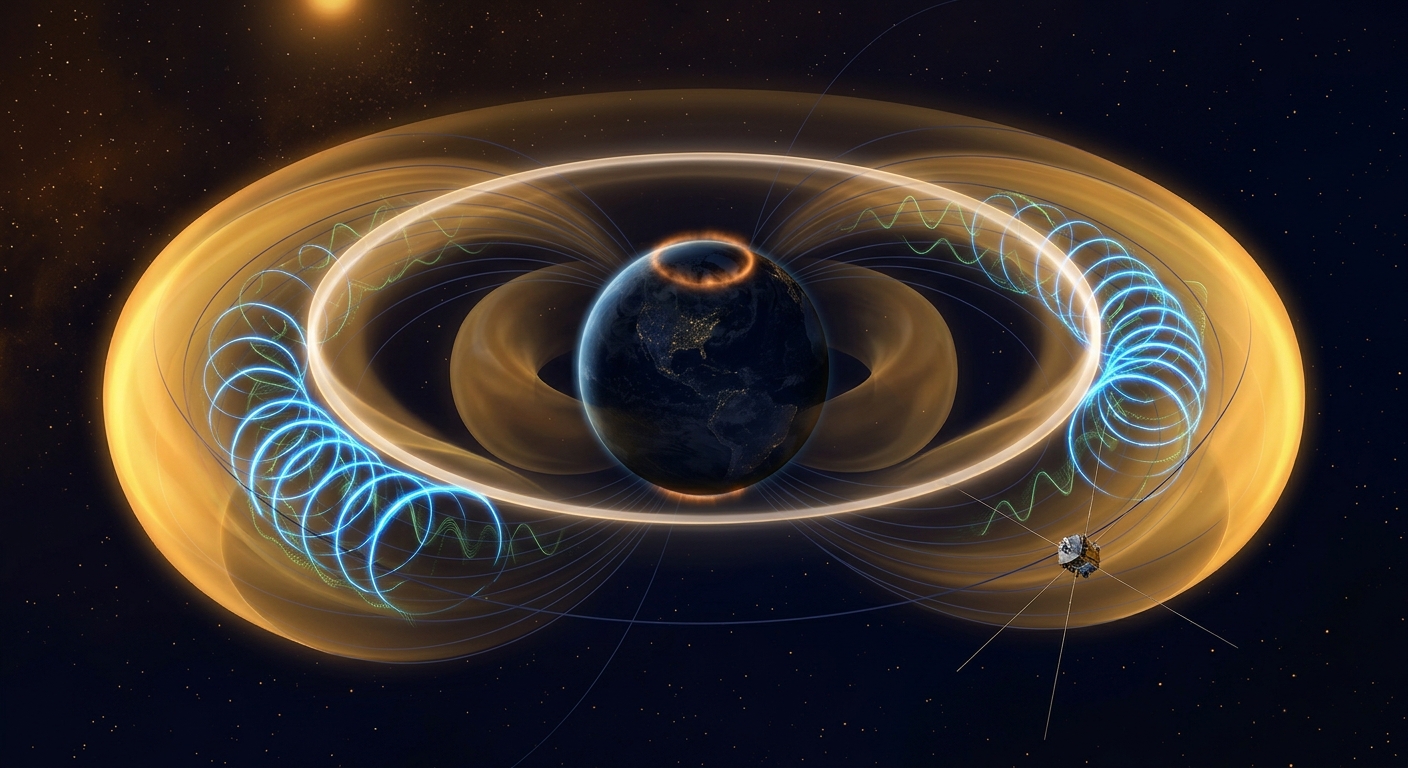
Earth is wrapped in radiation. James Van Allen’s team found it in 1958 with a Geiger counter aboard Explorer 1: charged particles trapped by our magnetic field in two doughnut-shaped belts. The inner belt is dominated by energetic protons; the outer belt by electrons, and it is the restless one. A solar storm can empty it in hours or fill it with electrons moving at a large fraction of the speed of light. Above a few million electron volts, those electrons can penetrate spacecraft shielding and build up charge inside electronics. Satellite operators call them killer electrons.
In 2014, a team led by Dan Baker, using NASA’s twin Van Allen Probes, noticed that the outer belt had an unexpectedly sharp inner edge. However hard a storm pushed, the most energetic electrons stopped at about 2.8 Earth radii out at the magnetic equator. They called it a nearly impenetrable barrier. The usual explanation is a balance: inside the barrier sits the plasmasphere, a cloud of cool, dense plasma fed from the ionosphere, where waves scatter energetic electrons away faster than they can creep inward.
Then came 10–11 May 2024. A huge sunspot group launched a string of eruptions, and Earth took its strongest geomagnetic storm since the Halloween storms of 2003. The aurora australis was photographed much further north than usual across Australia; Japan, which rarely sees aurora, saw it too.
Japan’s Arase satellite, launched by JAXA in 2016, was in the right place. It flies close to the magnetic equator straight through the belts and measures electrons, magnetic field, plasma waves and plasma density all at once. After the storm’s main phase, electrons of about three million electron volts climbed sharply inside the barrier — something never seen in ordinary storms across Arase’s record since 2017.
The new study, led by Yoshizumi Miyoshi of Nagoya University’s Institute for Space-Earth Environmental Research and published in Geophysical Research Letters on 26 October, asks the crucial question: were those electrons carried in from outside, or made where they were found? The answer comes from phase space density, a way of counting electrons with the same underlying orbital properties. If electrons stream in from outside, density is highest at the outer edge and falls inward. If they are accelerated locally, a peak appears in the middle. Arase saw a peak form at about L* = 3 — roughly 12,000 kilometres up, inside the barrier — and grow in place before spreading inward and outward.
The likely engine is chorus waves: natural radio emissions that, played through a speaker, sound like birds at dawn. Normally they cannot work in that region because the plasmasphere fills it. But the storm crushed the plasmasphere earthward, and a negative ionospheric storm drained the reservoir that normally refills it. For days, a region usually packed with cold plasma sat nearly empty, and Arase recorded intense chorus waves there just as the electrons grew.
Three caveats matter. This was one storm, a once-in-two-decades event. The authors describe the observations as consistent with chorus-driven acceleration — a strong case, not a direct proof. And the breach itself was not new: low-altitude satellites reported electrons rising inside the barrier in 2003, and earlier this year a Chinese-led team using the MSS-1 satellite with Arase reported the May 2024 violation. What this paper adds is the mechanism.
For engineers, the lesson is that a region long treated as comparatively calm for ultra-relativistic electrons can switch on in a rare, extreme storm. And with Solar Cycle 25 past its peak, it is worth remembering that the 2003 Halloween storms arrived well after Cycle 23 had peaked. The declining years still throw big punches.
There is a quieter lesson in how the result was reached. Arase’s data are processed and released openly by the ERG Science Center, run jointly by JAXA’s Institute of Space and Astronautical Science and Nagoya University. Rare events like May 2024 only reveal their mechanisms when a spacecraft has been measuring patiently for years beforehand, so that the extraordinary can be compared against the ordinary. Seven years of quiet storms are what made this one stand out.
Listen to The Weekend Wrap for the full story, plus a gamma-ray burst that only looked weak, the week that was, and a skywatch in which Halloween turns out to be a week early. Show notes and sources are at astronomydaily.io.