A Piece of Mars Older Than Almost Anything on Earth
Companion post · Astronomy Daily S05E218 · Friday 30 October 2026
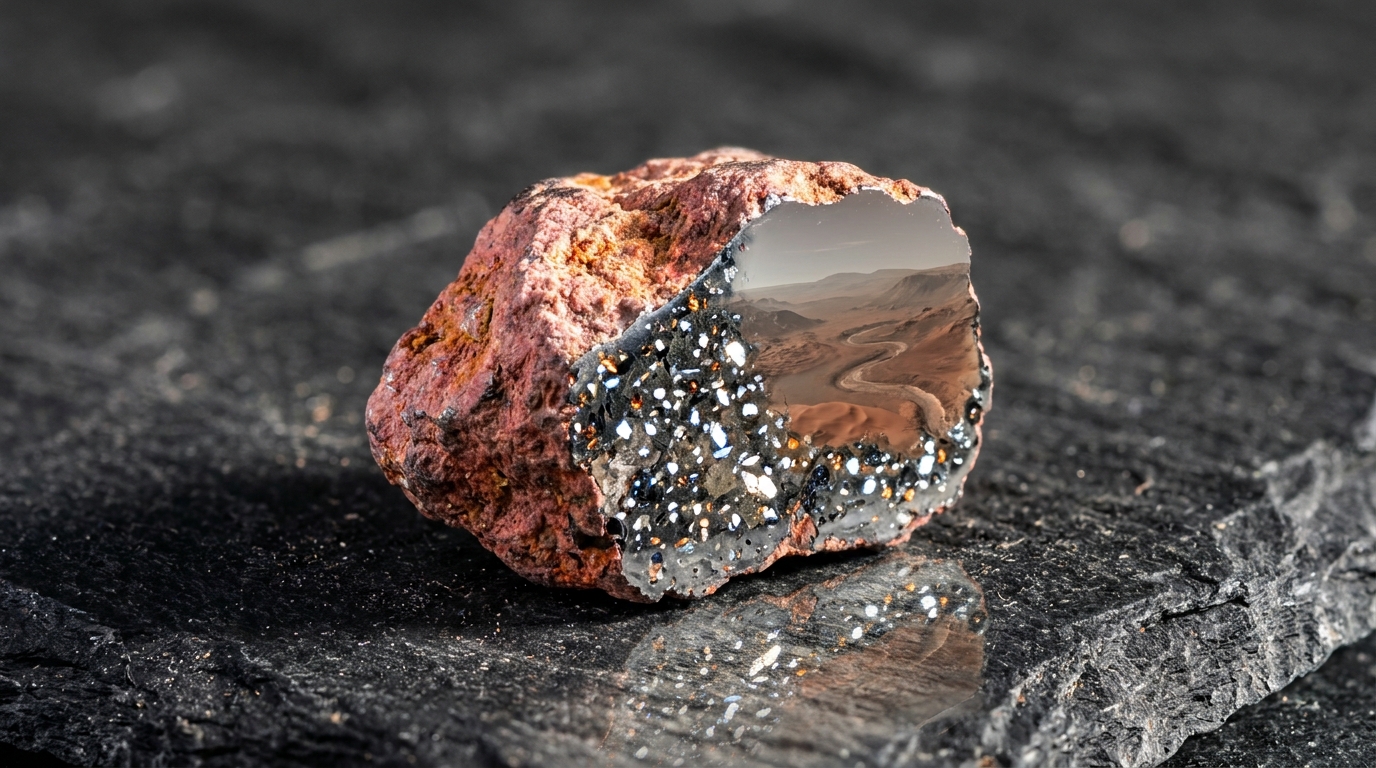
In September 2022, Sahrawi prospectors working the Sahara picked up a pinkish stone weighing about 800 grams. It looked unremarkable. This week, in a paper published in Science, a team led by Yang Liu at NASA’s Jet Propulsion Laboratory showed that the stone, now called Teghaza 001, is a piece of Mars that formed at least 4.1 billion years ago. That makes it one of the oldest Martian meteorites ever identified, and a rare sample of the planet’s earliest crust.
The first clue that it was Martian came from oxygen isotopes. Every rocky body in the Solar System carries a characteristic mix of the three stable isotopes of oxygen, and researchers at the University of New Mexico’s Institute of Meteoritics matched Teghaza’s to known Martian meteorites. At first it looked like a shergottite, the most common and generally youngest class of Martian meteorite. Most of the roughly 435 meteorites we have from Mars are no more than about two billion years old.
Then Liu found zircons. Zircon crystals take in uranium when they form, and that uranium decays to lead at a precisely known rate, so the crystals act as clocks. Ten zircon measurements gave a weighted average age of about 4,113 million years, give or take 14 million. A second, independent clock came from Francois Tissot’s laboratory at Caltech, which can date individual mineral grains in place using rubidium and strontium, on a fragment smaller than a fingernail and without destroying it. The two methods agreed.
There is a subtlety in that age. The minerals record alteration by water around 4.1 billion years ago. A rock has to exist before water can change it, so Teghaza formed at least that long ago and may be older still. The paper’s title says the rock formed at or before 4.1 billion years ago.
Two other well-known Martian meteorites are of comparable antiquity: ALH84001, found in Antarctica and made almost entirely of a single mineral, and NWA 7034, nicknamed Black Beauty, which contains very ancient fragments but was assembled much later. Teghaza is different because it is a slowly cooled igneous rock, a piece of crust that crystallised from magma. Its trace elements are richer than in any other igneous Martian meteorite except Black Beauty, and it came from a part of the Martian mantle the other meteorites did not sample.
Where on Mars did it come from? Nobody can say for sure. Comparing its chemistry with orbital measurements, the team found the closest matches in the heavily cratered southern highlands, some of the oldest terrain on the planet, and listed 13 candidate locations. Finding the exact source has precedent: in 2022 a Curtin University team in Perth traced Black Beauty to a crater on Mars they named Karratha.
The rock also bears on one of the biggest questions about Mars: what happened to its water. An earlier study by the same group this year used the hydrogen trapped inside Teghaza to show that Mars was already losing its water more than four billion years ago, before its global magnetic field is thought to have faded. Lee Saper, the paper’s second author, called it the first piece of Martian crust from a region we have never sampled.
A few caveats are worth keeping in view. The age was first shown at the Goldschmidt geochemistry conference in July; what is new is the complete, peer-reviewed description. The source location is a shortlist, not an identification. And one rock describes one patch of ancient crust, not the whole planet. Still, it is remarkable that a stone formed when Mars had rivers and lakes spent billions of years waiting, was blasted into space by an impact, crossed interplanetary space and landed in the Sahara for someone to pick up.
Also on today’s episode: Voyager 1 went silent for two days and recovered on its own as it approaches one light-day from Earth; Hubble finally saw the ‘Cat’s Tail’ of Beta Pictoris, debris from a collision between two Pluto-class worlds; two Halloween ghosts in the Carina Nebula; and the 100th US spacewalk from the space station. Listen to Astronomy Daily S05E218 wherever you get your podcasts, or at astronomydaily.io.